
POS Meaning Explained: Definitions, Uses, and Examples
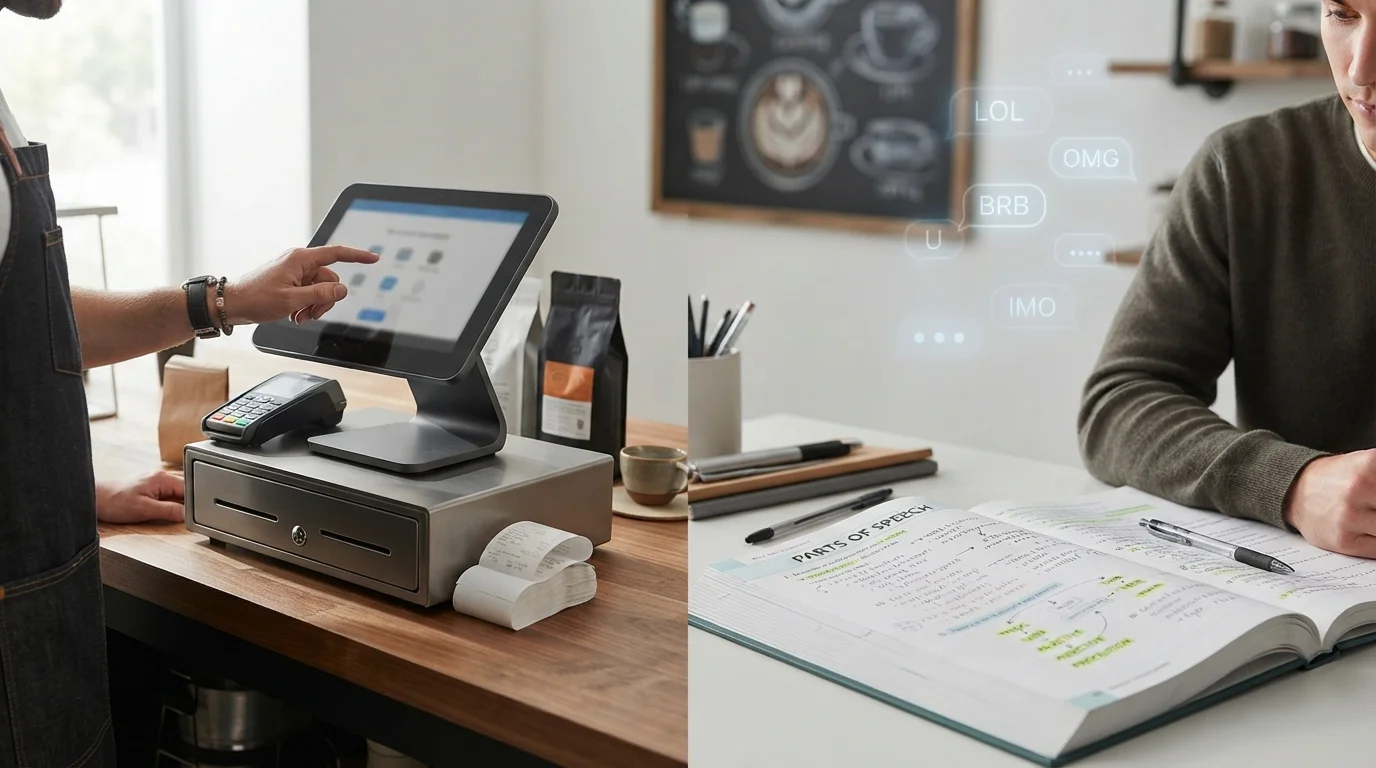
POS meaning can be confusing because the same three letters are used in several different ways. In one conversation, POS might refer to a retail checkout system. In an English class, it usually means parts of speech. In a text message or online chat, it may have an entirely different meaning. The right definition depends on the context.
If you’re interested in language, clever expressions, and the way words can take on multiple meanings, explore our Wordplay Puns category for more articles about acronyms, double meanings, puns, and other forms of creative wordplay.
This guide explains the most common meanings of POS in plain English, so you can quickly understand what someone is referring to. You’ll learn how the acronym is used in business, grammar, technology, and online conversations, along with simple examples that make each definition easy to remember.
Instead of focusing on just one meaning, this article brings them together in one place. That makes it easier to compare the different uses and avoid misunderstanding the term when you see it in a message, article, workplace, or classroom.
By the end, you’ll know how to recognize the correct POS meaning based on the situation, helping you read, write, and communicate with more confidence.
What Does POS Mean?
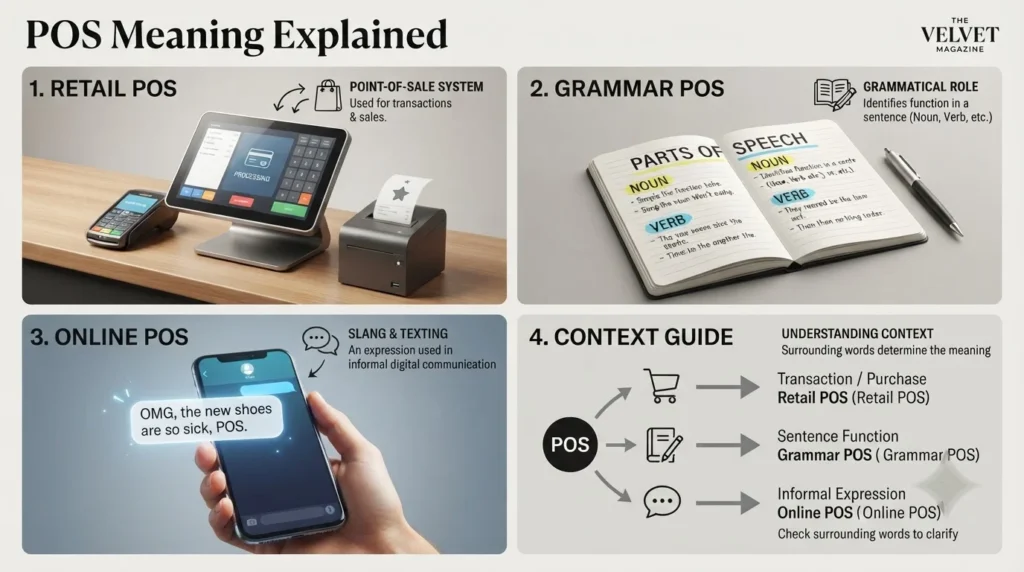
POS meaning depends entirely on the context. The acronym has several well-known definitions, with Point of Sale and Parts of Speech being the most common formal meanings. In casual online conversations, it can also be used as slang. Looking at where and how the term is used is the easiest way to identify the correct definition.
| Meaning | Common Context | Example |
|---|---|---|
| Point of Sale | Retail, restaurants, business | “The store installed a new POS system.” |
| Parts of Speech | English grammar, education | “Today’s lesson covers the eight POS categories.” |
| Internet Slang | Text messages, social media | “He used POS in a chat, but it wasn’t about business.” |
| Technology | Payment software, retail hardware | “The POS terminal accepted contactless payments.” |
Why POS Has More Than One Meaning
POS is an acronym, which means one set of letters can stand for multiple phrases. English has thousands of acronyms that work this way, and the intended meaning changes with the topic being discussed.
For example, if someone is talking about cash registers, receipts, or card payments, POS almost certainly means Point of Sale. If the discussion is about nouns, verbs, adjectives, or sentence structure, it refers to Parts of Speech. In texting or social media, the same letters may represent an informal slang expression instead.
This is why context matters more than the acronym itself. Rather than assuming a single definition, look at the surrounding words, the setting, and the subject of the conversation. Doing so helps you understand the intended POS meaning without confusion.
POS Meaning in Business and Retail
In business, POS meaning stands for Point of Sale. It refers to the place where a customer completes a purchase, whether that’s at a physical checkout counter, a self-service kiosk, or an online payment page. Today, the term also describes the hardware and software businesses use to process sales, accept payments, and manage daily operations.
A modern POS system does much more than print receipts. It helps retailers, restaurants, and service businesses handle transactions quickly while keeping track of inventory, customer information, and sales performance.
Modern businesses use POS technology to handle payments, track sales, and manage customer transactions. Industry resources from Shopify Retail Resources explain how retail technology supports daily operations.
Examples of POS Systems
You’ll find POS systems in almost every type of business, including:
- Grocery stores processing card and cash payments.
- Clothing retailers managing inventory and customer purchases.
- Restaurants taking table orders and printing kitchen tickets.
- Coffee shops accepting contactless and mobile payments.
- Salons and spas booking appointments and collecting payments.
In each case, the POS system acts as the central hub for completing sales and recording transaction data.
Common POS Features
Most modern Point of Sale systems include features such as:
- Payment processing for cash, credit cards, debit cards, and digital wallets.
- Barcode scanning for faster checkout.
- Inventory tracking to monitor stock levels.
- Receipt printing or digital receipts.
- Sales reports and business analytics.
- Employee management and user permissions.
- Customer loyalty programs and purchase history.
Businesses rely on these tools to improve efficiency, reduce manual work, and deliver a smoother checkout experience. When you see POS mentioned in retail, hospitality, or business discussions, it almost always refers to Point of Sale, making it the most widely recognized professional meaning of the acronym.
POS Meaning in Grammar
In grammar, POS meaning stands for Parts of Speech. These are the categories used to classify words based on their role in a sentence. Learning the parts of speech helps you understand how English sentences are built and improves both writing and communication.
Teachers, students, editors, and language professionals often use the abbreviation POS when discussing grammar rules, sentence structure, or language analysis.
The Eight Parts of Speech
English grammar traditionally includes eight parts of speech, each with a specific purpose:
| Part of Speech | Purpose | Example |
|---|---|---|
| Noun | Names a person, place, thing, or idea | teacher, city, book |
| Pronoun | Replaces a noun | he, she, they |
| Verb | Shows an action or state | run, think, is |
| Adjective | Describes a noun | happy, blue, tall |
| Adverb | Describes a verb, adjective, or another adverb | quickly, very, well |
| Preposition | Shows relationships between words | in, on, under |
| Conjunction | Connects words or clauses | and, but, because |
| Interjection | Expresses emotion | Wow! Ouch! Hey! |
For example, in the sentence “The quick fox jumps over the fence,” each word belongs to a specific part of speech. Understanding these categories makes it easier to identify grammar patterns, improve sentence construction, and communicate more clearly.
When POS appears in textbooks, grammar guides, dictionaries, or language-learning resources, it almost always refers to Parts of Speech, not business or internet slang.
POS Meaning in Texting and Online Slang
In texting and online conversations, POS meaning is very different from its formal definitions. It is commonly used as an abbreviation for an offensive insult. Because it can be rude or disrespectful, it’s generally best to avoid using it in professional settings or with people you don’t know well.
On social media, messaging apps, gaming platforms, and online forums, the meaning usually becomes clear from the conversation. If people are discussing business, POS probably means Point of Sale. If they’re talking about grammar, it likely means Parts of Speech. During a personal argument or heated exchange, however, it may be used as slang instead.
When You Should Avoid Using It
Since the slang version can offend others, consider these guidelines:
- Avoid using it in workplace emails or professional messages.
- Don’t assume everyone knows which meaning you intend.
- If you’re writing for a broad audience, spell out the full phrase instead of using the acronym.
- When reading messages, look at the surrounding conversation before deciding what POS means.
Using the full term—such as Point of Sale or Parts of Speech—can prevent confusion, especially in formal communication. In casual online chats, context remains the best clue for understanding the intended meaning.
POS Meaning in Computing and Technology
In technology, POS meaning usually refers to Point of Sale systems and the software or hardware that supports them. While this is closely related to retail, the technology behind a POS system deserves its own explanation because it includes much more than a cash register.
A POS setup typically combines devices and software that work together to process sales, manage inventory, and store transaction data. Depending on the business, the system may include:
- A touchscreen terminal or computer
- A barcode scanner
- A receipt printer
- A cash drawer
- A credit or debit card reader
- Customer display screens
- Cloud-based POS software
Many modern businesses now use cloud POS platforms, allowing owners to monitor sales, update inventory, and generate reports from almost anywhere with an internet connection. These systems also integrate with accounting software, e-commerce stores, customer loyalty programs, and employee scheduling tools.
For example:
- A retail store uses a POS system to process purchases and update stock automatically.
- A restaurant uses a POS terminal to send customer orders directly to the kitchen.
- A boutique tracks sales trends and inventory through cloud-based POS software.
Although you may occasionally see POS used in technical documentation or software manuals, it almost always refers to Point of Sale technology rather than grammar or internet slang. Understanding the surrounding topic makes it easy to identify the intended POS meaning.
How to Tell Which POS Meaning Is Intended
The easiest way to identify the correct POS meaning is to look at the context. The surrounding words, the topic of the conversation, and where the acronym appears usually make its definition clear. Instead of guessing, ask yourself what the discussion is about.
| If the conversation is about… | POS Most Likely Means |
|---|---|
| Cash registers, payments, receipts | Point of Sale |
| English class, writing, grammar | Parts of Speech |
| Online arguments or text messages | Internet slang |
| Retail software or payment terminals | Point of Sale |
Here are a few examples:
- “The restaurant upgraded its POS system.” → Point of Sale
- “The exam includes all eight POS categories.” → Parts of Speech
- “He used POS in a heated group chat.” → Internet slang
Quick Tips for Understanding POS
- Read the full sentence before deciding what the acronym means.
- Consider where you saw it—at work, in school, or on social media.
- Look for nearby words such as payment, register, noun, verb, or text message that provide clues.
- When writing for a general audience, spell out the full term the first time you use it to avoid confusion.
Because POS has multiple accepted definitions, context is always the most reliable guide. A single acronym can represent very different ideas, but the surrounding information usually points to the correct POS meaning within seconds.
Common Questions About POS
The acronym POS can create confusion because it appears in different fields, from business and education to online conversations. These are some of the most common questions people ask when they come across the term.
What does POS stand for?
POS can stand for different phrases depending on the situation. The most common meanings are Point of Sale in business and Parts of Speech in grammar. In informal online conversations, it may also refer to slang.
What does POS mean in a store?
In a store, POS means Point of Sale. It refers to the system used to complete customer purchases, process payments, print receipts, and manage sales information.
What does POS mean in grammar?
In grammar, POS means Parts of Speech. It describes the categories that explain how words function in a sentence, such as nouns, verbs, adjectives, and adverbs.
Is POS a bad word?
Sometimes. In online slang, POS can be used as an insult. However, in business and education, it is a completely normal abbreviation with no offensive meaning.
Why does POS have multiple meanings?
POS is an acronym, and many acronyms are reused across different industries and communities. The meaning changes based on the topic, audience, and situation where it appears.
How do I know which POS meaning someone means?
Look at the surrounding words and the conversation topic. Payment-related discussions usually mean Point of Sale, grammar discussions mean Parts of Speech, and casual online conversations may use the slang meaning.
Understanding the context behind the acronym is the easiest way to avoid misunderstandings.
Final Thoughts
The meaning of POS depends on where you see it and how it is being used. In business, it usually refers to Point of Sale, the system that helps companies process purchases and manage transactions. In grammar, it means Parts of Speech, the categories that describe how words work in sentences. Online, it may have an informal slang meaning.
Acronyms like POS show how flexible language can be. The same letters can represent completely different ideas depending on the situation. Paying attention to the topic, surrounding words, and audience will usually reveal the intended meaning quickly.
Whether you’re reading a business article, studying grammar, or scrolling through online conversations, understanding context is the key to interpreting words correctly. Small language details can completely change a message, which is what makes wordplay and language so interesting.
For more creative language content, explore more articles in our Wordplay Puns category, where you’ll find clever expressions, funny word connections, and interesting ways people use words.
The next time you see POS, don’t jump to one conclusion. Check the context first—the right meaning is usually hiding in the conversation around it.
Conclusion
The meaning of POS changes depending on the situation. In a store or business setting, it usually refers to Point of Sale, the system used to handle purchases, payments, and sales data. In grammar, it means Parts of Speech, the categories that explain how words function in sentences. In online conversations, it may have a slang meaning that depends on the tone and context.
Understanding acronyms is less about memorizing every possible definition and more about reading the clues around them. The words before and after an acronym often reveal what someone actually means.
Language is full of terms that can have multiple interpretations, and POS is a simple example of how context shapes communication. The same three letters can belong to business, education, technology, or casual conversations.
For more clever language topics, word connections, and creative examples, explore our Wordplay Puns category. Discover how words can create humor, confusion, and interesting conversations through different forms of wordplay.
FAQs
1. What is the most common POS meaning?
The most common POS meaning is Point of Sale, especially in business and retail. It refers to the system used to complete customer transactions, process payments, and manage sales information.
2. What does POS mean in grammar?
In grammar, POS stands for Parts of Speech. It refers to word categories such as nouns, verbs, adjectives, adverbs, pronouns, prepositions, conjunctions, and interjections.
3. What does POS mean in texting?
In texting and online conversations, POS can have a slang meaning. The exact meaning depends on the conversation, but it may sometimes be used as an insult.
4. Is POS always a negative term?
No. POS is not always negative. In business, technology, and education, it is a normal abbreviation with no negative meaning. Only certain slang uses may be offensive.
5. Why does POS have different meanings?
POS has different meanings because it is an acronym used by multiple industries and communities. Different fields often reuse the same letters for different phrases.
6. How can I know what POS means in a sentence?
Look at the surrounding context. Words related to payments and stores usually indicate Point of Sale, while grammar terms suggest Parts of Speech. Online conversations require looking at the tone and discussion.
7. What are other examples of words with multiple meanings?
Many words and acronyms have multiple meanings. Examples include “bat” (animal or sports equipment), “match” (a contest or something used to make fire), and abbreviations that change meaning across industries.
References
- Oxford English Dictionary — For language usage, word meanings, and historical definitions.
- Cambridge Dictionary — For grammar terminology and common English usage.
- Merriam-Webster Dictionary — For definitions of acronyms and everyday language.
- National Retail Federation — For retail technology and payment system concepts.
- Shopify Retail Resources — For explanations of modern retail POS systems.
- Toast Restaurant Resources — For restaurant POS technology and operational examples.