
11th Letter of the Alphabet Meaning Explained

If you’ve ever wondered about the 11th letter of the alphabet, the answer is simple: it’s K. While that may sound like an easy trivia question, the letter K has a surprisingly interesting story. It’s one of the few letters that can be loud in words like kangaroo but completely disappear in words like knife. That’s quite a career for a single letter.
The letter K appears everywhere—from classrooms and crossword puzzles to text messages, science, sports, and even internet slang. It has a distinctive sound, a long history, and a few spelling quirks that have confused generations of English learners. If you’ve ever paused before spelling knock or wondered why know starts with a silent letter, you’re in the right place.
This guide goes beyond simply naming the letter. You’ll learn where K came from, why it’s silent in some words, how it’s used in modern communication, and a few fun facts that make it far more interesting than its place in the alphabet suggests. If you’re also curious about language abbreviations and internet expressions, our guide to POS meaning provides another look at how short forms can take on completely different meanings depending on context.
And because this is The Velvet Magazine, we couldn’t resist sprinkling in a little wordplay along the way. After all, K has spent centuries being silent in some words—perhaps it’s just saving all its energy for a good punchline.
What Is the 11th Letter of the Alphabet?
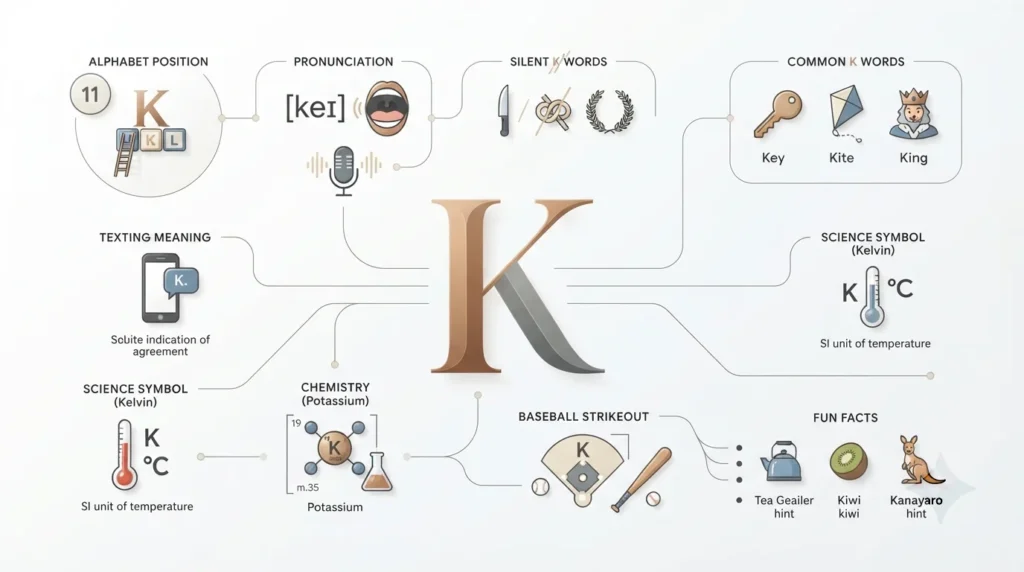
The 11th letter of the alphabet is K. It is a consonant pronounced “kay” and is used in thousands of English words. Although K isn’t among the most common letters in everyday writing, it plays an important role in spelling, pronunciation, abbreviations, and even modern digital communication.
At first glance, K seems pretty straightforward. It comes right after J and just before L, sitting comfortably in the middle of the alphabet. Yet it’s one of those letters that often surprises people. Sometimes it announces itself with a crisp sound, as in kite, kitten, keyboard, and king. Other times, it quietly steps aside and lets another letter do all the talking, as in knife, knee, knock, and know.
That silent behavior isn’t random. It’s the result of centuries of language evolution, where older pronunciations gradually changed while the spelling stayed behind. English is famous for keeping historical spellings, and K is one of its best examples. Think of it as the letter that kept showing up for work even after everyone stopped calling on it.
Outside of spelling, K wears plenty of other hats. In texting, a simple “K” can mean anything from “Okay” to “I’m not thrilled about this conversation,” depending on the context. In science, K represents the kelvin, the SI unit for temperature. In sports, baseball fans know a K records a strikeout, while in mathematics, the letter often stands in for a constant or variable.
For word lovers, K is also a favorite because it starts memorable words like kindness, knowledge, koala, kayak, and kaleidoscope. It’s not the busiest letter in the alphabet, but it certainly knows how to make an impression—sometimes by making a sound, and sometimes by staying perfectly quiet.
The more you look at K, the more you realize it’s a letter full of personality. Next, we’ll see why K became the 11th letter of the alphabet and how it found its place in the English language.
Why Is K the 11th Letter?
K is the 11th letter because the modern English alphabet inherited its order from ancient alphabets that developed over thousands of years. Its position wasn’t chosen at random. Instead, it was passed down through the Phoenician, Greek, Latin, and eventually English writing systems, where the sequence remained largely unchanged.
The story begins more than 3,000 years ago. The ancient Phoenicians used a letter called Kaph, which represented a sound similar to today’s K. When the Greeks adapted the Phoenician alphabet, they turned Kaph into Kappa (Κ, κ). Later, the Romans adopted much of the Greek alphabet to create the Latin alphabet, which became the foundation of modern English.
Interestingly, the Romans didn’t rely on K very often. They preferred the letter C for many of the same hard sounds. That’s why classical Latin contains relatively few words beginning with K. Over time, however, English borrowed vocabulary from many languages—including Old English, Germanic languages, Greek, and others—giving K a much larger role than it had in Latin.
One of K’s most recognizable features came from Old English spelling. Words such as knight, knee, knife, and know were once pronounced with both the K and the N. As spoken English evolved, people gradually stopped pronouncing the K, but the traditional spelling remained. It’s like a family heirloom that everyone keeps even though nobody remembers exactly why it was first placed on the shelf.
If letters held annual awards, K would probably win “Best Supporting Character.” It rarely steals the spotlight, yet English spelling would look very different without it. Imagine writing nife, nee, or nowledge. They look oddly unfinished, as if the word forgot to wear its first shoe.
The history of K shows that the alphabet isn’t just a list of letters—it’s a timeline of languages, cultures, and centuries of change. Understanding that history also makes K’s unusual spelling habits much easier to appreciate.
For a deeper explanation of why silent letters survive in modern English, Merriam-Webster’s guide to silent letters offers helpful historical context that explains how pronunciation changed while spelling stayed largely the same.
How Do You Pronounce the Letter K?
The letter K is pronounced “kay” when you say its name, and it usually makes a hard /k/ sound in words. You’ll hear this crisp consonant at the beginning of words like kite, key, kangaroo, and kitchen, where the back of your tongue briefly touches the roof of your mouth before releasing the sound.
Unlike some English letters that have multiple common pronunciations, K is refreshingly consistent. In most words, if you see a K, you can expect the familiar hard sound:
- Kind
- Kid
- King
- Kick
- Kitchen
- Koala
- Kayak
- Keyboard
This consistency makes K one of the easier consonants for young readers and English learners to recognize. It’s one reason phonics lessons often introduce K alongside C when teaching the hard /k/ sound.
That said, English enjoys keeping people on their toes. K sometimes shares its job with C, CK, and Q, all of which can produce a similar sound.
For example:
| Spelling | Example | Sound |
|---|---|---|
| K | Kite | /k/ |
| C | Cat | /k/ |
| CK | Duck | /k/ |
| Q | Queen | /k/ (followed by /w/) |
Even though these letters can sound alike, they follow different spelling patterns. That’s why you’ll write kite with a K but cat with a C. English spelling isn’t trying to be difficult—it simply carries rules and traditions from many different languages.
Of course, K has one famous exception: sometimes it doesn’t make any sound at all. When K appears before N at the beginning of certain words, it’s usually silent. That’s why knee sounds like nee and knock sounds like nock.
It’s a little ironic that one of the alphabet’s clearest-sounding letters also has a reputation for disappearing without warning. If K had a personality, it would probably announce itself loudly at most parties but occasionally sneak out the back door without saying goodbye.
Why Is K Sometimes Silent?
K is usually silent when it appears before N at the beginning of a word. These spellings come from older forms of English, where both letters were once pronounced. Over hundreds of years, speakers gradually dropped the K sound, but the spelling stayed the same.
Some of the best-known examples include:
- Knife
- Knee
- Knock
- Know
- Knit
- Knuckle
- Knot
These silent spellings may seem unusual today, but they’re small reminders of how languages change over time. English pronunciation evolved much faster than its spelling, leaving K to quietly preserve a bit of linguistic history—without making a sound about it.
Common Words That Start With K
The letter K begins thousands of English words, from everyday vocabulary to scientific terms and place names. While it isn’t as common as letters like S or T, K starts plenty of familiar words that people use every single day.
Some K words are among the first that children learn to read. Others show up in school, the workplace, the kitchen, or even on vacation. Together, they prove that K may not be the busiest letter in the alphabet, but it’s certainly a useful one.
Here’s a selection of common K words organized by theme:
| Category | Examples |
|---|---|
| Everyday Objects | Key, Keyboard, Kettle, Kite |
| People & Traits | Kid, King, Kind, Keeper |
| Nature & Animals | Koala, Kangaroo, Kiwi, Kelp |
| Food | Kiwi, Kale, Ketchup, Kimchi |
| Places & Travel | Kingdom, Kingdom Hall, Kilometre*, Kayak |
| Action Words | Keep, Kick, Knit, Kneel |
| Learning | Knowledge, Keyword, Kindergarten, Keyboard |
*In American English, kilometer is the standard spelling.
One of the most interesting K words is knowledge. It begins with a silent K, reminding us that spelling doesn’t always match pronunciation. Then there are words like key, which unlocks doors, keyboard, which helps us communicate, and kindness, which costs nothing but can brighten someone’s day.
K also appears in many words borrowed from other languages. Kimchi comes from Korean cuisine, karaoke has Japanese roots, and kayak originated from the language of the Inuit people. These borrowed words show how English has grown by welcoming vocabulary from cultures around the world.
For fans of word games, K can be surprisingly valuable. It appears less often than many other letters, making K words useful in crossword puzzles, word searches, and games like Scrabble. Knowing a few unusual K words can sometimes be the difference between an average score and a winning one.
Speaking of unusual words, K seems to enjoy collecting interesting neighbors. It hangs out with Koalas in Australia, paddles kayaks across rivers, and somehow still finds time to guard the keys. That’s a pretty busy schedule for the 11th letter of the alphabet.
If you’re interested in more playful language, you might also enjoy our guide to wordplay puns, where simple words become clever jokes through sound, spelling, and double meanings.
What Does “K” Mean in Text Messages?
In text messages, “K” is usually a shortened form of “OK,” but its meaning depends heavily on context and tone. It can signal agreement, end a conversation quickly, or, in some situations, come across as cold or annoyed—even when that wasn’t the sender’s intention.
At its simplest, K = OK. It’s a fast reply when someone asks a straightforward question.
For example:
- “I’ll be there at 6.” → K
- “Don’t forget your charger.” → K
- “The meeting starts in ten minutes.” → K
In these cases, K simply acknowledges the message. It’s short, efficient, and gets the job done.
Things become more interesting when emotions enter the chat. Because text messages don’t include facial expressions or voice tone, a single letter can feel very different depending on the conversation.
Here’s how people often interpret it:
| Reply | Common Impression |
|---|---|
| OK | Friendly and neutral |
| Okay | Casual and conversational |
| Ok! | Positive and enthusiastic |
| K | Brief, neutral, or possibly distant |
| K… | Hesitant or unhappy, depending on context |
Of course, these aren’t fixed rules. One person may use K because they’re busy, while another might use it to end a conversation. That’s why it’s always better to consider the relationship and the situation before reading too much into a one-letter reply.
K also appears in other digital contexts:
- 10K often means ten thousand.
- 4K refers to ultra-high-resolution video.
- In some online games, K can stand for a keyboard player or be part of shorthand used by the community.
- On social media, you’ll often see K used in numbers, such as 25K followers for 25,000 followers.
For a single letter, K carries an impressive workload. It can start a word, finish a conversation, count to thousands, measure video quality, and occasionally spark the classic text-message mystery: “Are they upset, or are they just in a hurry?”
Fortunately, most of the time, the simplest explanation is the right one. More often than not, K just means “Okay.” Up next, we’ll look at some surprising facts about K that most people never notice, from word games to science and beyond.
Fun Facts About the Letter K
The letter K may be the 11th letter of the alphabet, but it has one of the most interesting personalities. From silent spellings to scientific symbols, K appears in places many people never notice. Here are a few facts that make this consonant worth a second look.
1. K Wasn’t Always Silent
Words like knife, knee, and knock weren’t always pronounced the way they are today. Centuries ago, speakers actually pronounced both the K and the N. Over time, the K sound faded from everyday speech, but the spelling stayed exactly where it was.
2. K Means Different Things in Different Fields
The same letter can have completely different meanings depending on where you see it:
- Science: K is the symbol for kelvin, the SI unit of temperature.
- Chemistry: K is the chemical symbol for potassium, derived from the Latin word kalium.
- Sports: In baseball scorekeeping, a K represents a strikeout.
- Technology: 4K describes an ultra-high-definition screen resolution.
- Math: K is often used as a variable or constant in equations.
That’s a lot of responsibility for one letter.
3. K Isn’t One of the Most Common Letters
Compared with letters like E, T, or A, K appears much less often in English writing. Even so, it begins plenty of memorable words, including kindness, keyboard, kangaroo, and knowledge.
4. Scrabble Players Love Seeing K
In Scrabble, the letter K is worth 5 points. It’s valuable enough to boost your score but common enough to use in everyday words. A well-placed K can turn an average move into a winning one.
5. K Travels the World
Many familiar K words entered English from other languages. Karaoke comes from Japanese, kimchi from Korean, and kayak from the language of the Inuit people. English has a long history of borrowing useful—and sometimes delicious—words from around the globe.
6. K Has a Quiet Sense of Humor
No other letter is quite as comfortable making noise and staying silent at the same time. It boldly introduces itself in kite and kitten, then quietly slips into the background in know and knight. If the alphabet held talent shows, K would probably perform a magic trick and disappear halfway through the act.
The letter K proves that even a single character can carry centuries of history, countless meanings, and a surprising amount of personality. Up next, we’ll finish with some lighthearted K wordplay and clean puns that give the 11th letter of the alphabet the final laugh.
K Wordplay and Clean Puns
The letter K has plenty of comedic potential, especially because it can be loud in one word and completely silent in the next. That mix of sound, spelling, and surprise makes it perfect for lighthearted wordplay that’s fun for all ages.
Here are a few original, clean K-themed jokes and puns to end on a smile.
K One-Liners
- The letter K is so humble, it sometimes doesn’t even pronounce itself.
- K joined a choir but stayed silent during every knumber.
- I asked K why it never bragged. It said, “Actions speak louder than consonants.”
- K doesn’t ghost words—it simply practices silent communication.
- If confidence had a favorite letter, it would probably be K… because it’s always okay being itself.
Short Q&A Jokes
Why did K bring a flashlight to spelling class?
Because silent letters like to stay in the dark.
Why is K good at keeping secrets?
It has years of experience staying quiet.
What did the word “knife” say to K?
“Thanks for showing up, even if nobody hears you.”
Why did K enjoy crossword puzzles?
Because it always knew where it fit.
Pun Corner
- Stay K-alm and carry on.
- Be K-ind—it’s one letter that always leaves a good impression.
- Every great idea starts with a little K-nowledge.
- Some letters shout for attention. K lets its spelling do the talking.
- K doesn’t need the spotlight—it already has the right character.
The best language jokes often come from everyday words rather than complicated punchlines. The letter K is a perfect example. It’s familiar enough for everyone to recognize but quirky enough to inspire clever observations. Whether it’s hiding in silent spellings, standing for scientific symbols, or casually replying to texts with a single character, K proves that even one letter can have a surprisingly entertaining story.
Conclusion
The 11th letter of the alphabet is K, but there’s much more to it than its position in the ABCs. From its ancient origins and distinctive pronunciation to its silent role in words like knife and know, K has a fascinating history that continues to shape modern English.
Beyond spelling, K appears in texting, science, mathematics, sports, and everyday conversations. It also adds personality to countless words, making it one of the most recognizable consonants despite being less common than many others.
Whether you arrived here looking for a quick answer or stayed for the fun facts and wordplay, one thing is clear: K may sometimes stay silent, but it’s never boring.
Frequently Asked Questions
1. What is the 11th letter of the alphabet?
The 11th letter of the English alphabet is K. It is a consonant pronounced “kay” and is used in words such as key, kite, kind, and kangaroo.
2. Is K a vowel or a consonant?
K is a consonant. It usually makes the hard /k/ sound at the beginning or middle of English words.
3. Why is K silent in words like knife and know?
In Old English, both the K and N were pronounced. Over time, the K sound disappeared in speech, but the traditional spelling remained, creating the silent K we see today.
4. What does K mean in texting?
In text messages, K is usually a shortened version of “OK.” Depending on the conversation, it can simply acknowledge a message or, in some cases, seem brief or distant.
5. What are some common words that start with K?
Popular K words include key, kite, king, kitchen, keyboard, kind, kangaroo, koala, kettle, and knowledge.
6. What does K represent in science?
In science, K is the symbol for kelvin, the International System of Units (SI) base unit for temperature. In chemistry, K is also the chemical symbol for potassium, derived from the Latin word kalium.
7. Why is the letter K important?
K is important because it helps form thousands of English words and serves as a symbol in many fields, including science, mathematics, technology, sports, and digital communication. Its silent spellings also make it a unique part of English pronunciation.
References
- Merriam-Webster Dictionary
- Encyclopaedia Britannica
- Oxford Reference
- Cambridge Dictionary
- Oxford English Dictionary (OED)