A Coo Sticks: The Pun That Sounds Better Than It Looks

A coo sticks.
Read it quickly, and your brain might wonder, “Wait… what does that even mean?” Say it out loud, and the joke clicks. The phrase sounds like “acoustics,” the science of sound. That tiny sound switch is what makes this kind of wordplay so satisfying.
A good pun does not need a complicated setup, a long story, or a dramatic punchline. Sometimes all it needs is a few ordinary words standing in the right order. A coo sticks takes a simple bird sound and turns it into a clever language trick.
This style of humor belongs to the world of homophones, where words or phrases sound alike but carry completely different meanings. It is the same reason a dad joke can make someone groan and laugh at the same time. Your brain expects one meaning, then suddenly takes a small detour.
If you enjoy understanding how word meanings change in playful language, you’ll love exploring how simple phrases can become jokes through sound, spelling, and timing.
The best part? This joke works on two levels. Someone who hears it quickly gets the funny image of a pigeon’s “coo” sticking somewhere. Someone who notices the hidden word gets the extra reward of realizing it was really about sound all along.
That little “ohhh, I get it” moment is the secret ingredient behind memorable wordplay. And that is exactly why a coo sticks has earned a place among the tiny jokes that prove language can be surprisingly funny.
What Does “A Coo Sticks” Mean?
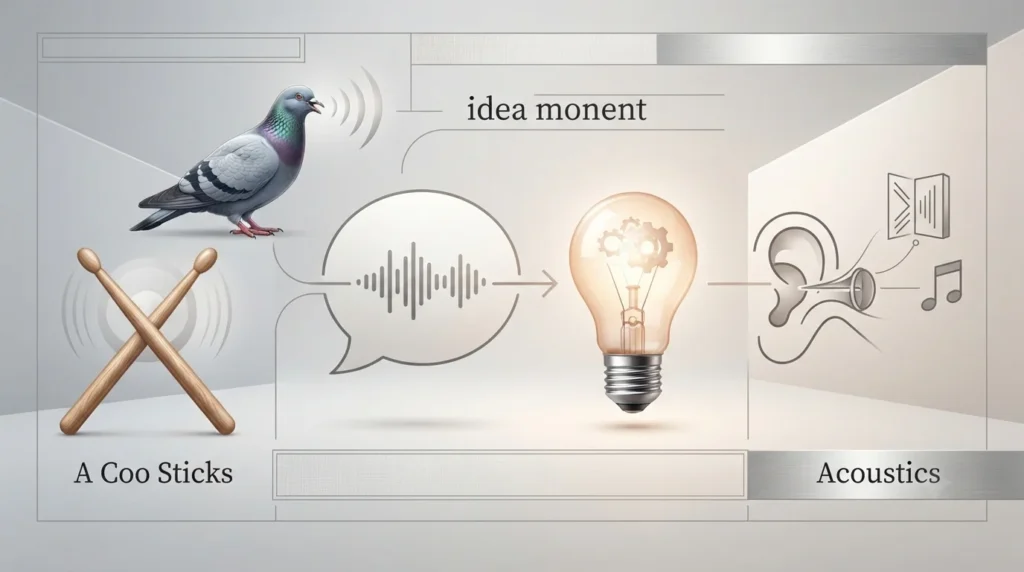
“A coo sticks” is a sound-based pun that sounds like the word “acoustics,” which refers to the way sound behaves, travels, and is heard. The joke creates a funny contrast by imagining a bird’s coo physically sticking somewhere instead of simply being a sound.
The humor comes from hearing the phrase before understanding it. At first, “a coo sticks” sounds like a strange little sentence about a bird. Maybe a pigeon made a noise that got stuck on a wall. Maybe a tiny bird walked around carrying a sticky sound. The image is silly because sounds do not usually have a place to land.
Then the second meaning appears: acoustics.
That quick change from a ridiculous picture to a real word is what gives the joke its charm. Your brain takes a short trip from “bird noise problem” to “science term,” and the surprise creates the laugh.
This type of joke is a classic example of phonetic wordplay. Instead of changing the spelling of a word, it changes how the listener interprets the sounds. The words are doing double duty, which is why short puns can sometimes feel smarter than longer jokes.
The phrase also works because it combines two unrelated ideas:
- A coo, the soft sound made by birds like pigeons and doves.
- Acoustics, the study of sound and how it moves through spaces.
Putting a bird noise next to a scientific concept creates an unexpected connection. It is the same reason people enjoy jokes that turn ordinary words into surprising meanings.
For readers who love clever humor, these tiny language tricks are often the most memorable. They do not rely on shock value or a long setup. They simply wait for your brain to notice the hidden connection.
And that moment of discovery is where the joke lives. The phrase was never really about a bird losing its voice — it was about how one little sound can completely change the way we understand a word.
The Sound Trick Behind the Pun
The reason a coo sticks works so well is that your ears and your brain are briefly playing a little game. You hear a group of familiar sounds, but your mind has to decide what those sounds mean. That tiny moment of confusion is where the humor appears.
When spoken aloud, “a coo sticks” and “acoustics” are close enough to create a connection. The joke depends on the listener hearing the phrase, then mentally rearranging it into something recognizable. It is almost like a tiny word puzzle hidden inside a sentence.
This is the magic of homophones and sound-alike phrases. A joke does not always need a surprising story or an unexpected action. Sometimes the surprise comes from realizing that two completely different ideas can live inside the same sound.
Think about hearing someone say:
- “I used to be a baker, but I couldn’t make enough dough.”
- “The scarecrow won an award because he was outstanding in his field.”
- “The musician opened a bakery because he wanted to make more bread.”
The humor comes from words doing double jobs. “Dough” can mean money or baking material. “Field” can mean a career area or a piece of land. “Bread” can mean food or cash. Your brain recognizes both meanings and enjoys the collision.
“A coo sticks” follows the same formula but adds a visual twist. Instead of simply hearing “acoustics,” the listener gets a funny mental picture of a bird sound becoming a physical object. It turns an invisible thing — sound — into something you can imagine touching.
That is why wordplay puns are popular with families, comedians, and especially fans of dad humor. They are clean, quick, and usually rely on clever thinking rather than complicated setups. A listener does not need background knowledge or a specific cultural reference. They only need to hear the words.
The best sound-based jokes feel like a small discovery. They make people pause for half a second before the meaning lands. That delayed reaction — the classic “wait… oh!” moment — is often the difference between a forgettable joke and one someone wants to share.
Why “A Coo Sticks” Is Such a Clever Wordplay Joke
A coo sticks works because it combines a familiar sound, an unexpected meaning, and a silly mental image in just a few words. The joke follows the classic structure of great wordplay: something sounds ordinary at first, then reveals a second meaning that surprises the listener.
Short jokes often have the biggest advantage: they leave room for the reader’s brain to participate. Instead of explaining everything, a good pun lets people make the connection themselves. That small moment of discovery creates the laugh.
This is why wordplay has stayed popular for generations. A joke built around language can work almost anywhere — at the dinner table, in a classroom, at work, or in a group chat. It does not need a complicated setup or a perfect delivery. The words themselves carry the punchline.
The phrase also has a playful mismatch that makes it memorable. Acoustics is a serious scientific term connected to sound, rooms, music, and technology. A “coo sticking” sounds like a completely ridiculous situation involving a bird and a mysterious sticky noise. Putting those two ideas together creates the comedy.
It is the same reason many classic dad jokes work. They take normal words and push them into an unusual direction. The humor is often predictable once you hear it, but that does not make it less enjoyable. In fact, the predictability is part of the charm.
A joke like this also proves that humor does not always need to be loud. Some jokes are funny because they are clever enough to make you think for a second. They reward attention instead of demanding it.
That is the beauty of sound-based puns: they turn everyday language into a playground. A simple phrase can become a science lesson, a bird joke, and a tiny brain teaser all at once.
And when a joke can make someone smile while also making them think, it has already done its job.
The Magic of Homophones
Homophones are words or phrases that sound the same or almost the same but have different meanings. They are one of the favorite tools of comedians because they create surprise by making listeners rethink what they just heard.
The phrase a coo sticks is a perfect example of how sound can completely change a joke. Your ears hear one thing, but your brain searches for the meaning behind it. Once the connection to “acoustics” appears, the humor suddenly makes sense.
Homophones are everywhere in everyday language. Some are exact matches, like “flower” and “flour,” while others rely on similar sounds, like “a coo sticks” and “acoustics.” These little sound overlaps give writers endless opportunities to create jokes, captions, and clever phrases.
The fun comes from the gap between what people expect and what they discover. A listener may picture a bird making a noise that somehow gets stuck, which is already a funny image. Then the word transforms into something completely different: a term connected to sound itself.
That switch is why homophone jokes often feel like mini puzzles. The audience gets to solve the joke instead of simply receiving it. The laugh comes from the realization.
Many classic dad jokes use this same technique:
- Why did the bicycle fall over?
Because it was two-tired. - Why did the tomato turn red?
Because it saw the salad dressing. - Why did the computer go to the doctor?
Because it had a virus.
These jokes work because one word suddenly takes on another meaning. “Tired” becomes a reference to bicycle tires. “Dressing” becomes both clothing and salad topping. “Virus” becomes both a computer problem and an illness.
According to the Merriam-Webster Dictionary, homophones are words that are pronounced the same but differ in meaning or spelling. This simple language feature has helped create some of the most recognizable forms of wordplay.
The charm of homophone humor is that it feels accessible. You do not need to memorize comedy techniques or understand complicated references. You just need to listen closely and notice when language takes an unexpected turn.
That is why tiny phrases like a coo sticks can stay in your head. They remind us that words are not just tools for communication — they can also be toys for creativity.
When Pigeons Meet Science Humor
There is something wonderfully strange about mixing a tiny bird sound with a serious scientific idea. That is exactly why a coo sticks works. It takes something ordinary — a pigeon’s gentle “coo” — and places it next to a word that belongs in a classroom, not a birdhouse.
Pigeons and doves are known for their soft cooing sounds. It is a simple noise that most people recognize instantly. You do not need a wildlife degree to imagine a bird sitting on a rooftop making that familiar sound.
Now add acoustics, the study of sound. Suddenly, the joke creates a funny little collision between nature and science. A bird becomes connected to a subject involving sound waves, recording studios, concert halls, and how voices travel through spaces.
That contrast is what gives the pun its personality.
Great humor often comes from unexpected combinations. A chef wearing a superhero cape. A cat acting like a strict office manager. A pigeon accidentally becoming a sound engineer. When two unrelated ideas meet, the brain notices the unusual connection.
Animal puns especially work well because animals already have strong personalities in our minds. Dogs are loyal, cats are mysterious, owls seem wise, and pigeons often get portrayed as busy city characters. Giving a pigeon a connection to acoustics creates a funny little character without needing a full story.
Imagine a pigeon walking into a recording studio:
“Don’t worry,” it says. “I specialize in acoustics. My coos are my credentials.”
It is silly, but that is the point. The joke is not trying to be realistic. It is creating a playful world where language makes impossible things feel logical.
This type of humor is common in clean comedy because it works for almost everyone. Kids enjoy the funny image, while adults appreciate the word connection. It sits comfortably in the world of family humor, dad jokes, and clever one-liners.
The best puns often make ordinary things feel new. A bird sound becomes a science concept. A simple phrase becomes a tiny comedy puzzle. And for a few seconds, a pigeon is no longer just making noise — it is apparently teaching a lesson in sound.

Funny “A Coo Sticks” Style Puns You Can Share
A good sound-based pun does not stop at one joke. Once you understand how a coo sticks works, you start noticing how many everyday words can hide a second meaning. The fun comes from taking a normal phrase and giving it a playful twist.
These jokes are not about making the most complicated punchline possible. The best ones are quick, clean, and easy to repeat. They create that familiar reaction: a small groan followed by a smile.
Here are some original wordplay ideas inspired by the same style:
Bird-Themed Wordplay
1. Why did the pigeon become a radio host?
Because it already had a great coo-munication style.
2. The pigeon opened a music studio.
Everyone said it had the best bird tracks in town.
3. Why did the owl start a podcast?
Because it was great at giving wise words.
4. The robin joined the choir.
It wanted to improve its tweet-ming skills.
5. Why did the duck become a comedian?
Because every joke ended with a perfect quack-up.
Animal puns work because they give creatures human traits. A bird does not actually host a radio show or record music, but imagining it does creates the joke. The silliness is what makes the connection memorable.
Sound and Science Puns
Sound-related humor has a special advantage: everyone experiences sound every day. We hear music, voices, noises, and conversations constantly, so these jokes feel familiar.
Try these:
1. The musician broke up with the metronome.
It was too controlling and kept setting the pace.
2. The microphone went to therapy.
It had too many issues amplifying its feelings.
3. The speaker was confident at parties.
It always knew how to make an entrance.
4. The echo got into trouble.
It kept repeating what it was told.
5. The sound engineer became a detective.
They were excellent at finding the right clues.
Like a coo sticks, these jokes rely on taking a normal concept and flipping its meaning. They create humor by making invisible things — sounds, voices, and noises — feel like characters with personalities.
That is the charm of wordplay. A single word can become a story starter.
A microphone can have feelings. An echo can have bad habits. A pigeon can accidentally become a sound expert. The joke works because language gives us permission to imagine the impossible. And sometimes the funniest ideas come from simply listening to words a little differently.
Why Simple Puns Like This Stay Memorable
Simple puns stay memorable because they create a quick mental surprise. They take familiar words, add an unexpected meaning, and give the reader a small moment of discovery. That combination makes short jokes easier to remember and share.
The human brain loves patterns. When we hear a phrase, we naturally try to predict what comes next. A good pun interrupts that prediction and sends the thought in a different direction.
That is exactly what happens with a coo sticks. At first, the phrase seems like it is describing a strange bird situation. Then the hidden connection appears, and suddenly the listener understands the real joke. The humor comes from the switch.
Long jokes often depend on storytelling, characters, and timing. Puns take a different route. They are tiny language puzzles. The setup and punchline are often packed into the same few words.
This is why people remember jokes like:
- I only know 25 letters of the alphabet. I don’t know y.
- I used to hate facial hair, but then it grew on me.
- I’m reading a book about anti-gravity. It’s impossible to put down.
These jokes are not memorable because they are complicated. They work because one word suddenly changes jobs. A letter becomes a missing piece of the alphabet. “Grew on me” becomes both personal growth and actual hair growth. “Impossible to put down” becomes a joke about floating objects.
Sound-based humor has another advantage: people can share it easily. A short phrase fits perfectly into a text message, social media caption, conversation, or family gathering. It does not require a long explanation before the laugh arrives.
This is also why dad jokes have survived for so long. Their charm comes from being predictable but clever. Everyone knows the joke might be coming, but they still enjoy the small language trick hiding inside it.
A phrase like a coo sticks proves that humor does not always need a dramatic punchline. Sometimes the funniest moments come from looking at ordinary words from an unusual angle.
The best wordplay makes people do two things at once: smile and think. That tiny mental jump is what turns a simple phrase into a joke people remember.
More Clever Wordplay Examples
Once you start noticing sound-based humor, everyday language begins to feel like a giant joke book hiding in plain sight. Words can sound similar, carry multiple meanings, or create funny images when taken literally. That is why wordplay has remained one of the easiest forms of humor to share.
A phrase does not need a complicated story to work. Sometimes the funniest jokes are created when one word unexpectedly takes a different path.
Here are a few examples of the same kind of playful thinking behind a coo sticks:
Why did the math book look sad?
Because it had too many problems.
The joke works because “problems” can mean both math questions and personal troubles. A simple word creates two possible meanings.
Why did the gardener get promoted?
Because they were outstanding in their field.
The phrase “field” sounds ordinary until you realize it has two meanings: an area of work and an actual piece of land.
Why did the calendar get nervous?
Because its days were numbered.
A calendar really does contain numbered days, but the phrase also suggests limited time. That little double meaning creates the humor.
Why did the coffee file a police report?
Because it got mugged.
The joke takes “mug” from a cup into a crime-related meaning. It is a tiny language switch that creates the surprise.
These jokes share the same foundation as many classic puns: the listener expects one meaning, but the joke reveals another. That sudden change is what makes the phrase satisfying.
Wordplay can also turn ordinary phrases into funny situations. A person might say:
- “The bakery hired a new employee because they kneaded the help.”
- “The bicycle shop was tired of bad reviews because customers kept giving it a spin.”
- “The musician was good at fixing problems because they always found the right note.”
This style of humor appears everywhere, from comedy shows to advertisements to everyday conversations. It works because language already contains hidden possibilities. Writers simply arrange the pieces in a way that creates surprise.
The same idea appears in jokes like the clever wordplay behind 45 cents, where numbers and sounds combine to create an unexpected meaning. These tiny twists remind us that humor is often hiding in the way we say things, not just in what we say.
The beauty of wordplay is that it rewards curiosity. The more attention you give to language, the more jokes you begin to notice. A simple phrase can become a riddle, a story, or a punchline — sometimes all at once.

Conclusion
A coo sticks is a perfect example of how a few simple sounds can create a surprisingly clever joke. On the surface, it sounds like a strange phrase about a bird’s noise getting stuck somewhere. But once you hear the connection to acoustics, the joke transforms into a small language puzzle.
That is the charm of wordplay. The funniest moments are not always the loudest ones. Sometimes they come from a tiny shift in meaning that makes your brain pause and say, “Wait… I get it.”
Sound-based jokes, homophones, and double meanings continue to work because they invite people to participate. The listener is not just hearing a joke — they are solving it. That little discovery creates the smile.
From pigeons becoming sound experts to everyday words hiding multiple meanings, clever humor proves that language can be playful. A simple phrase can create an image, teach a concept, and deliver a laugh at the same time.
So the next time you hear a strange combination of words, listen a little closer. There might be a hidden punchline waiting inside.
Frequently Asked Questions
What does “a coo sticks” mean?
“A coo sticks” is a wordplay joke that sounds like “acoustics,” the study of sound. The humor comes from imagining a bird’s coo sticking somewhere while actually referring to a scientific term related to sound.
Why is “a coo sticks” considered a pun?
It is considered a pun because it uses similar sounds to create two different meanings. The phrase depends on phonetic similarity between “a coo sticks” and “acoustics.”
What type of joke is “a coo sticks”?
“A coo sticks” is a sound-based wordplay joke. It uses a homophone-style technique, where a phrase sounds like another word or concept.
Why do people enjoy homophone jokes?
People enjoy homophone jokes because they create a small surprise. The listener first understands one meaning, then discovers another meaning hidden in the same sounds.
Are puns considered a type of wordplay?
Yes. Puns are one of the most common forms of wordplay. They use sounds, spelling, or multiple meanings of words to create humor.
Why are dad jokes often based on puns?
Dad jokes often use puns because they are clean, simple, and easy for everyone to understand. Their predictable style is part of their charm.
Can animals be used in wordplay jokes?
Yes. Animal-based humor is popular because animals already have recognizable traits and sounds. Adding human ideas or language twists creates funny and memorable jokes.
References
- Merriam-Webster Dictionary
- Cambridge Dictionary
- Encyclopaedia Britannica
- Oxford Reference
- Oxford English Dictionary
- The Linguistic Society of America