Science Jokes for Kids That Make Learning Fun

Science and laughter actually have a lot in common: both make people curious. A good question leads to a discovery, and a good joke leads to a smile. That’s why science jokes for kids are such a fun way to mix learning with laughter.
From giggling at a confused atom to laughing about a sleepy planet, science has plenty of funny ideas hiding inside its biggest concepts. Kids already love asking “why,” and science humor gives them one more reason to stay curious.
This collection brings together clean, kid-friendly jokes inspired by space, weather, animals, chemistry, physics, and everyday experiments. Some jokes are silly, some are clever, and some are the kind of jokes that make kids roll their eyes before laughing anyway — the true sign of a great joke.
If your child enjoys funny questions, clever wordplay, and classroom-friendly humor, they’ll find plenty to enjoy here. Science jokes can turn a homework break into a laugh break, make a science lesson more memorable, or simply give families something funny to share together.
For even more kid-friendly laughs across different topics, explore our collection of jokes for kids, where science is just one part of a bigger world of playful humor.
So grab your imaginary lab coat, adjust your scientist glasses, and get ready for some seriously silly discoveries.
Why Science Jokes for Kids Make Learning More Fun
Science jokes for kids make learning more enjoyable by turning tricky ideas into simple laughs. They use familiar science words, concepts, and discoveries in playful ways, helping children connect with subjects like space, animals, weather, and experiments.
Science can sometimes feel like a giant puzzle filled with complicated words. But humor makes those words feel friendlier. When a child laughs at a joke about gravity, planets, or molecules, they’re also hearing science concepts in a way that feels easy and memorable.
Think about it: a textbook might explain that gravity pulls objects toward Earth. A joke might say, “Gravity is a great friend because it always keeps us grounded.” The science idea stays the same, but the joke makes it easier to remember.
That’s the magic of wordplay. Science humor often uses double meanings, silly comparisons, and unexpected answers. Kids learn that words can have different meanings, which strengthens both creativity and problem-solving skills.
Understanding the meaning behind scientific words can make these jokes even easier to enjoy, and resources that explain scientific terms and definitions can help readers explore new vocabulary.
Science jokes also work well because kids naturally love discovering how things work. A funny joke about an exploding volcano, a talking animal, or a traveling astronaut can spark a bigger conversation about real science.
Teachers and parents often use humor because a quick laugh can make a lesson feel less intimidating. A child who laughs at a science joke may become more interested in asking questions, exploring ideas, and learning something new.
Science and comedy might seem like opposites, but they make a surprisingly good team. One explains the world. The other makes the world a little more fun.
Funny Science Jokes for Kids That Are Lab-Tested Laughs
Science is full of strange facts, unusual discoveries, and words that sound like they were invented by a very creative wizard. That makes it perfect material for jokes. From tiny atoms to giant experiments, there is always room for a little humor in the lab.
These jokes mix simple science ideas with silly twists that kids can understand and share. Some are classic-style jokes, while others put a fresh spin on familiar science concepts.
Classic Science Puns and One-Liners
Science puns work because they take serious ideas and give them a playful makeover. A tiny change in wording can turn a normal science term into something completely silly.
Here are some clean science laughs for curious minds:
Why did the scientist install a light bulb?
Because he wanted to have a bright idea.
What did the thermometer say after a long day?
“I’m feeling a little under pressure.”
Why did the atom bring a suitcase?
Because it was ready to split and go somewhere new.
What do you call a dinosaur that knows a lot of science?
A dino-sore-ologist.
Why did the scientist take a ladder into the lab?
Because the experiment needed to reach new heights.
What did one molecule say to another molecule?
“I’ve got my ions on you.”
Why are chemistry jokes so easy to understand?
Because they always get a reaction.
What did the microscope say to the tiny object?
“Don’t worry, I’ll help you get noticed.”
Why did the student bring a pencil to science class?
Because they wanted to draw some conclusions.
What did the volcano say when it was surprised?
“I lava good joke!”
Science jokes often work because they make kids look at ordinary words differently. A “reaction” can be something happening in a science experiment or the way people respond to a joke. That little twist is what creates the laugh.
Silly Scientist Jokes Kids Will Love
Scientists spend their days asking questions, testing ideas, and discovering new things. In jokes, they also become characters who accidentally create funny situations.
Here are some playful scientist-inspired jokes:
Why did the scientist become a gardener?
Because they wanted to grow their own experiments.
What did the young scientist say after finishing homework?
“Experiment complete. Snack time begins.”
Why did the scientist bring a ladder to the laboratory?
Because they wanted to study high-level science.
What happens when a scientist tells a bad joke?
The audience conducts a “laugh test.”
Why did the scientist carry a notebook everywhere?
Because great ideas don’t like being forgotten.
What did the experiment say when it was finished?
“Results may vary, but fun is guaranteed.”
The best science humor doesn’t need complicated formulas to work. It simply takes something kids recognize — a classroom, a science tool, or a big scientific word — and gives it a funny personality.
That’s why science jokes are great for family dinners, school breaks, and those moments when someone says, “Science is boring.” A well-timed joke might prove otherwise.
Space Jokes for Kids That Are Out of This World
Space jokes for kids take humor to a whole new level because the universe is already full of strange and amazing things. Floating planets, talking about aliens, traveling rockets, and endless galaxies give jokes plenty of room to take off.
Astronomy can sometimes feel huge and complicated, but a funny space pun can make the topic feel much closer. Kids may not remember every detail about a planet right away, but they’ll probably remember laughing about a joke involving one.
Here are some cosmic jokes that are ready for launch:
Why did the astronaut break up with the moon?
Because it needed some space.
What do you call a spaceship that tells jokes?
A comedy rocket.
Why did the sun go to school?
Because it wanted to become a little brighter.
What did the planet say after a long day?
“I need some space.”
Why did the astronaut bring a pencil into space?
Because they wanted to draw their own orbit.
What do stars use to clean their houses?
A meteor mop.
Why was the moon always invited to parties?
Because it knew how to shine.
What did Mars say to Earth?
“Stop calling me your neighbor. You’re making me feel planet-ary.”
Why did the astronaut take a computer to space?
Because they wanted to visit the space bar.
What did the rocket say before takeoff?
“Time to blast off and have some fun!”
Planet, Rocket, and Astronaut Wordplay
Space humor often comes from words that already sound funny. Terms like “orbit,” “launch,” “meteor,” and “gravity” create lots of opportunities for playful jokes.
For example, a planet can “need space” in two ways: it can need room in the universe, or someone can need personal space after a busy day. That type of double meaning is what makes wordplay so enjoyable for kids.
Try these extra space laughs:
Why don’t astronauts get lost?
Because they always follow their star map.
What did the alien say when it landed on Earth?
“Take me to your reader.”
Why did the rocket get a good grade?
Because it was outstanding in its field.
What do you call a moon that tells jokes?
A lunar-tic comedian.
Why did the astronaut sit on the clock?
Because they wanted to be on time for orbit.
Space jokes do more than create laughs. They also help kids become comfortable with science vocabulary. Words like planets, stars, and galaxies become part of everyday conversations instead of feeling like distant textbook topics.
A child who laughs at an astronaut joke today might become the kid asking questions about black holes, rockets, or life beyond Earth tomorrow. Sometimes curiosity starts with a simple punchline.
Weather Jokes for Kids That Bring the Forecast of Fun
Weather jokes for kids turn everyday things like rain, clouds, storms, and sunshine into reasons to laugh. Since children experience weather every day, these jokes feel familiar while adding a silly twist to things they already understand.
A rainy afternoon, a windy day, or a bright sunny morning can become the perfect setup for a joke. Weather humor also helps kids connect fun ideas with science concepts like temperature, seasons, clouds, and storms.
Here’s a forecast you can count on: plenty of laughs ahead.
Why did the cloud stay home from school?
Because it felt a little foggy.
What did one raindrop say to the other?
“Two’s company, but a cloud’s a crowd.”
Why did the sun go to therapy?
Because it had too many bright ideas.
What do you call a funny storm?
A thunder-laugh.
Why did the weather report bring a pencil?
Because it wanted to draw the forecast.
What did the tornado say to the messy room?
“I’ll clean this place up in seconds.”
Why was the lightning bolt so good at making decisions?
Because it always struck at the right moment.
What did the snowman say when the weather got warmer?
“I’m melting under pressure.”
Why did the cloud break up with the rain?
Because it needed some space to clear things up.
What did the thermometer say during summer?
“I’m feeling pretty hot about this.”
Cloud, Storm, and Temperature Jokes
Weather jokes are fun because nature already acts like a character. Clouds can “feel sad,” storms can “get angry,” and sunshine can “smile.” These little imaginary details make science concepts easier for kids to remember.
A cloud doesn’t really have feelings, of course, but pretending it does creates a funny story. This kind of creative thinking helps children play with language while learning about the world around them.
More weather laughs coming your way:
Why don’t clouds ever get lost?
Because they always follow the current forecast.
What did the rain say after winning a race?
“I poured my heart into it.”
Why did the wind get detention?
Because it kept blowing things out of proportion.
What is a tornado’s favorite game?
Spin the bottle.
Why did the snowflake bring a camera?
Because it wanted to capture a cool moment.
What did the hurricane say after finishing a big job?
“That was a whirlwind of activity.”
Weather humor is a great reminder that science is happening all around us. Kids don’t need a laboratory to see science in action — they can look outside and find clouds, sunlight, wind, and rain creating a real-life science show.
For more STEM-style laughs, weather jokes can pair perfectly with other school-friendly humor topics, including our collection of math jokes for kids for children who enjoy numbers, puzzles, and clever problem-solving.
The forecast for today? A 100% chance of giggles.
Chemistry, Biology, and Physics Jokes for Curious Kids
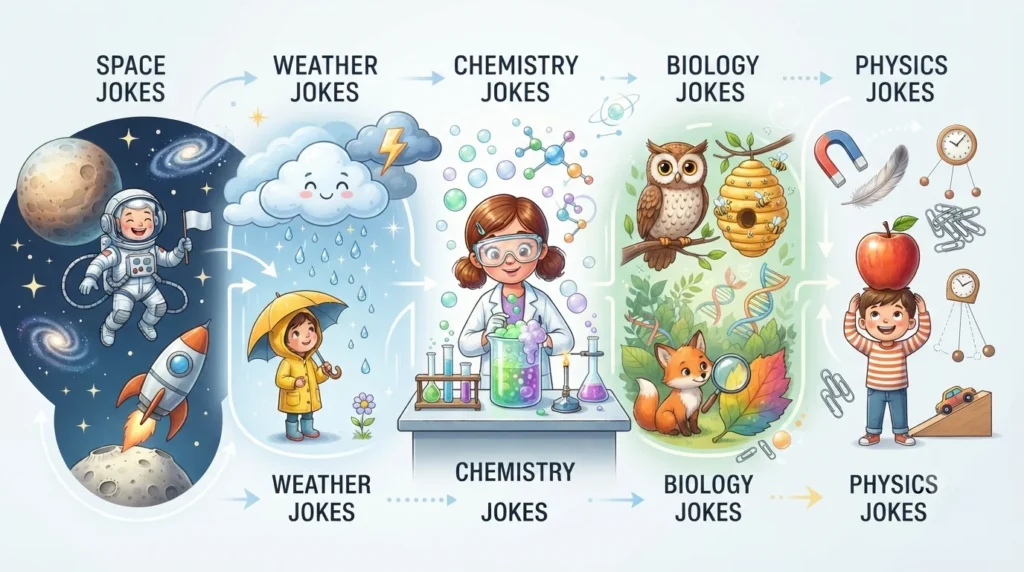
Science has many branches, and each one comes with its own collection of funny possibilities. Chemistry gives us elements and reactions, biology gives us living things, and physics explains how everything moves.
These areas might sound serious, but they are full of words that are perfect for jokes. A “reaction” can happen in a lab or after hearing a funny punchline. A “cell” can be part of a living thing or a place where someone stays. That little surprise is what makes science wordplay so entertaining.
Let’s take a trip through some of the funniest corners of science.
Chemistry Jokes That Get a Reaction
Chemistry jokes are popular because elements and experiments already sound like they belong in a comedy show. With names like helium, carbon, and oxygen, the periodic table has plenty of material for clever humor.
Here are some chemistry laughs:
Why did the scientist bring a ladder to the chemistry lab?
Because they wanted to reach a higher level of reaction.
Why are chemists great at solving problems?
Because they always have the right solution.
What did one chemical element say to another?
“I think we have great chemistry.”
Why did the bottle of acid feel confident?
Because it knew it was a strong character.
What did oxygen say when it met magnesium?
“OMG!”
Why did the atom stop telling jokes?
Because nobody could understand its chemistry.
Chemistry jokes show kids that even scientific words can have personality. They make unfamiliar terms feel less intimidating and more playful.
Biology Jokes Full of Life
Biology is all about living things, which means there are endless opportunities for jokes about animals, plants, and the human body.
Try these:
Why did the plant go to school?
Because it wanted to improve its roots.
What did the cell say when it finished a race?
“I finally made it to the finish membrane.”
Why are mushrooms invited to every party?
Because they are such fun guys.
Why did the scientist study frogs?
Because they wanted to learn about natural jump-starts.
What did the tree say after hearing a funny joke?
“That really grew on me.”
Biology humor works because kids already know and love animals, plants, and nature. A simple joke can turn a science lesson into something they can easily remember.
Physics Jokes That Move the Crowd
Physics explains the forces that shape our world — from gravity pulling us down to energy making things happen. It also creates some wonderfully silly jokes.
Here are a few:
Why was the physics book always stressed?
Because it had too many problems.
Why did the bicycle fall over?
Because it was two-tired.
What did gravity say to the apple?
“Don’t worry, I’ve got you covered.”
Why did the scientist bring a rubber band to physics class?
Because they wanted to study elasticity.
Why do physicists love shortcuts?
Because they are always looking for the path of least resistance.
Physics jokes are a fun reminder that science is not just about memorizing facts. It’s about understanding how the world works — and sometimes laughing at how strange that world can be.
Science may explain why things happen, but humor explains why we smile when they do.
How to Use Science Jokes at Home or School
Science jokes are more than quick laughs. They can be useful tools for teachers, parents, and kids who want to make learning feel more exciting. A funny science pun at the right moment can turn a regular lesson into something children remember.
At home, parents can use science humor during homework time, car rides, dinner conversations, or family game nights. A simple joke about planets, animals, or experiments can lead to bigger conversations about how things work.
In classrooms, teachers often use humor as a warm-up activity or a way to introduce a new topic. A joke about gravity before a physics lesson or a silly animal pun before biology can help students feel more comfortable with the subject.
Fun Ways Teachers and Parents Can Share Science Humor
There are plenty of creative ways to bring science jokes into everyday learning.
Start the day with a science joke.
A funny question on a classroom board or a note in a lunchbox can create a positive mood before learning begins.
Use jokes as conversation starters.
After sharing a joke, ask kids why it is funny. This helps them think about word meanings, science concepts, and creative connections.
Create a family science joke challenge.
Everyone can make their own science pun and vote on the funniest one. The winner earns the title of “Chief Comedy Scientist.”
Add humor to science projects.
A funny project name, silly experiment title, or creative presentation can make school assignments more memorable.
Match jokes with lessons.
Learning about planets? Share a space joke. Studying weather? Add a cloud or storm pun. Exploring animals? Bring in biology humor.
Science jokes also help children see that learning does not always have to feel serious. Curiosity and creativity often grow when kids feel relaxed and interested.
A child who laughs at a joke about atoms might start asking questions about molecules. A funny weather pun might lead to curiosity about storms. A silly animal joke might inspire interest in nature.
That is the best part about science humor: the laugh might only last a few seconds, but the curiosity it creates can last much longer.
Science and comedy may seem like different worlds, but they share something important — both encourage people to look closer, ask questions, and discover something new.
Conclusion
Science is full of amazing discoveries, but it does not always have to feel like a serious classroom subject. A funny joke about planets, weather, animals, or experiments can make science feel more approachable and exciting for kids.
The best science jokes for kids do more than create a quick laugh. They introduce new words, encourage curiosity, and show children that learning can be playful. A clever pun about gravity, a silly space joke, or a chemistry one-liner might be the small spark that makes a child want to ask more questions.
Humor and science have always been a great pair. Science helps us understand the world, while jokes help us enjoy it. So the next time a child says science is boring, try adding a little laughter to the experiment.
After all, every great discovery starts with curiosity — and sometimes curiosity starts with a really good joke.
FAQs
What are science jokes for kids?
Science jokes for kids are funny jokes based on scientific ideas like space, animals, weather, chemistry, physics, and experiments. They use simple wordplay and silly situations to make science topics more entertaining and easier for children to enjoy.
Why are science jokes good for children?
Science jokes help kids connect learning with fun. They can make difficult concepts feel less intimidating, improve vocabulary, encourage creativity, and help children remember science-related ideas through humor.
What are some good science jokes for kids?
Good science jokes for kids include jokes about atoms, planets, animals, weather, scientists, and experiments. The best ones are simple, clean, and use science words in a funny or unexpected way.
Are space jokes for kids educational?
Yes, space jokes for kids can help children become more familiar with astronomy terms like planets, stars, astronauts, and galaxies. While the jokes are mainly for fun, they can encourage interest in learning more about space.
What makes science puns funny?
Science puns are funny because they use double meanings, wordplay, and familiar scientific terms in surprising ways. For example, a word like “reaction” can describe both a chemistry process and someone’s response to a joke.
Can teachers use science jokes in classrooms?
Yes, teachers can use science jokes as warm-up activities, lesson introductions, classroom rewards, or discussion starters. A quick joke can make students feel more engaged and comfortable with science topics.
What are weather jokes for kids?
Weather jokes for kids are jokes based on natural events like rain, clouds, storms, snow, and sunshine. They combine everyday weather experiences with playful word choices to create simple science humor.
References
- Merriam-Webster
- Encyclopaedia Britannica
- Cambridge Dictionary
- Oxford Reference
- National Aeronautics and Space Administration (NASA)