Math Jokes for Kids That Make Numbers Fun
Math can sometimes feel like a giant puzzle full of numbers, formulas, and problems waiting to be solved. But who says numbers cannot be funny? Math jokes for kids turn everyday concepts like counting, shapes, and equations into silly moments that make children smile while giving their brains a little workout.
A good math joke works like a tiny brain teaser. Kids hear a familiar word, expect one answer, and then get surprised by a clever twist. That little “aha!” moment is what makes puns, riddles, and one-liners so memorable.
From a calculator with an attitude to a triangle that has too many angles to deal with, math humor gives kids a playful way to connect with a subject they may not always love. The best part? These jokes are easy to share at school, around the dinner table, or with friends.
If your family already enjoys clean humor, you can find more laughs in our collection of jokes for kids, where silly stories, wordplay, and kid-friendly comedy come together.
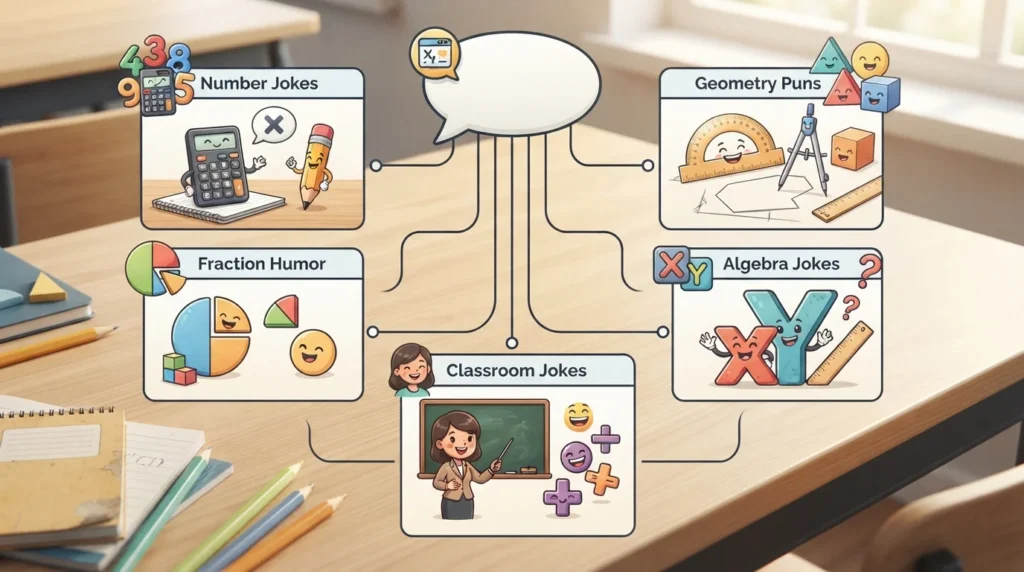
This collection of funny math jokes for kids includes everything from quick number jokes to clever math puns, classroom giggles, and corny dad-style humor. Some jokes are simple enough for younger children, while others sneak in a little extra wordplay for older kids who enjoy a challenge.
Because sometimes the easiest way to make math less scary is to let it tell the punchline.
Why Math Jokes for Kids Make Learning More Fun
Math jokes for kids make learning more enjoyable because they connect numbers with something children naturally love: laughter. When a child laughs at a clever equation joke or a silly number pun, they are not just hearing a punchline — they are practicing patterns, recognizing meanings, and building positive feelings around math.
Humor gives math a different personality. Instead of seeing numbers as boring symbols on a worksheet, kids start noticing that math ideas appear everywhere. A circle can become a joke about being “well-rounded,” and a calculator can become a character with a very serious job.
Funny math jokes for kids also help create small confidence boosts. A child who remembers a joke about fractions or geometry may feel more comfortable talking about those same concepts in class. The goal is not to replace learning with comedy, but to make the subject feel friendlier.
Teachers and parents often use humor for this reason. A quick joke before a lesson or during homework time can break tension and make a challenging topic feel lighter.
Math has rules, but humor knows how to bend them. That unexpected twist is exactly where the fun begins.
When Numbers Become the Punchline
Numbers become funny when kids recognize familiar math ideas in unexpected situations. A joke about a “square meal” or a “sharp angle” works because it takes a normal phrase and gives it a mathematical twist.
This type of wordplay helps children see that math is not only about solving problems. It is also about noticing patterns, making connections, and looking at ideas from a new angle.
The funniest math jokes usually keep things simple. A young child may laugh at a joke about counting, while an older student might enjoy a joke about algebra or geometry. Either way, the magic comes from turning something ordinary into something surprising.
Funny Math Jokes for Kids That Always Get a Giggle
The best math jokes are the ones kids can remember five minutes later and tell someone else five minutes after that. A great punchline does not need a complicated formula — sometimes the funniest moments come from a simple number, a silly question, or a word with two meanings.
These funny math jokes for kids are designed for classrooms, family dinners, homework breaks, and anytime someone needs a quick laugh. Some are classic-style jokes, while others add a fresh twist to familiar math ideas.
Short Math One-Liners
Short jokes are perfect for kids because they are easy to share. A one-line math joke can turn a boring moment into a quick laugh, especially when the punchline arrives faster than a calculator can finish a problem.
Here are some quick math giggles:
- Why was the math book sad?
Because it had too many problems. - I told my calculator a joke.
It said, “I can’t solve that one.” - Why did the number 6 avoid the number 7?
Because 7 was always acting odd. - My math teacher loves fractions.
She says they are a big part of her day. - Why did the equal sign feel so calm?
Because it knew everything would balance out. - I tried to make a belt out of watches and rulers.
It was a waist of time and measurement. - Why did the pencil take a math class?
It wanted to become a sharp student. - The number zero told eight, “Nice belt!”
Eight replied, “Thanks, it’s my favorite accessory.” - Why did the triangle bring a jacket?
Because it was feeling a little chilly from all its angles. - My homework asked me to find X.
I told it, “If I knew where X was, I wouldn’t need homework.”
These quick jokes work because they mix familiar math ideas with everyday situations. Kids already know numbers, pencils, homework, and classrooms — the humor comes from giving those ordinary things a funny personality.
Silly Number Jokes
Numbers may look serious on a worksheet, but they have plenty of personality when they step into a joke. Number humor often uses counting, patterns, and the funny ways we describe certain digits.
Here are some more number-based laughs:
- Why was the number 10 always invited to parties?
Because it was perfect for counting on. - What did one number say to another during an argument?
“Let’s add things up before we subtract each other.” - Why did the number 4 bring a ladder?
It wanted to reach a higher level. - What is a math teacher’s favorite place to visit?
Times Square. - Why did the number 2 look nervous?
It was stuck between a rock and a hard number. - What did the decimal say during the race?
“I’m just trying to get ahead by a few points.” - Why did the fraction break up with the whole number?
It felt like things were not adding up.
Numbers are everywhere, which makes them perfect for playful humor. A child who laughs at a number joke is also practicing the habit of seeing patterns — one of the same skills that helps with math itself.
Math Puns That Are Clever Enough for Kids
Math puns are where numbers and language team up to create some of the funniest jokes. They work because many math words have everyday meanings too. A “square,” a “point,” or a “root” can mean different things depending on how you use them.
That little word twist is what makes a good pun satisfying. Kids get the fun of recognizing the math idea while enjoying the surprise ending. It is like solving a tiny joke problem where the answer is laughter.
These math puns are great for kids who enjoy wordplay, classroom humor, and jokes that make them think for a second before they laugh.
Geometry Jokes About Shapes and Angles
Geometry is full of shapes, lines, and angles — which means it is also full of opportunities for silly jokes. Triangles, circles, and squares may not have faces, but they definitely have personalities in the world of humor.
Here are some shape-filled laughs:
- Why was the circle so popular?
Because it was well-rounded. - Why did the triangle always win arguments?
Because it had a point. - Why did the square refuse to fight with the circle?
It did not want to get around the issue. - What did the angle say when it was feeling amazing?
“I’m looking sharp today.” - Why did the rectangle go to the doctor?
It was feeling a little out of shape. - Why are circles so good at keeping secrets?
Because they never have a point. - Why did the geometry student bring a map?
They wanted to find the right direction. - What did one line say to another line?
“You have a very straight personality.” - Why did the triangle sit quietly during class?
It did not want to make a scene with all its points.
Geometry jokes are especially fun because kids can actually picture the punchline. A triangle having “a point” or a circle being “well-rounded” creates a funny image in their minds.
For anyone curious about why words can have multiple meanings and create humor, dictionaries like Merriam-Webster explain how language develops different uses over time.
Algebra and Equation Jokes
Algebra might introduce letters into math, but that does not mean it has to feel mysterious. Once kids understand variables, equations, and solving for unknowns, algebra becomes a perfect playground for jokes.
Here are some algebra-inspired laughs:
- Why did the variable go to therapy?
It had too many unknown issues. - Why was the equation so confident?
It knew it could solve its problems. - What did X say when everyone kept looking for it?
“I’m right here. Stop making me the mystery!” - Why did the algebra book look stressed?
It had too many problems with unknown answers. - Why did the student love algebra?
Because every problem had a chance to become a solution. - What did the calculator say after solving a hard equation?
“I need a little rest — I’ve been counting on myself.”
Algebra jokes work best when kids already recognize the language of equations. The humor comes from treating math problems like real-life problems, giving numbers and symbols human emotions.
After all, even a variable deserves a little attention. It has been waiting years for someone to finally find it.
Classroom Math Jokes for Students and Teachers
A classroom is one of the best places for math humor because every student knows the daily struggles: homework, quizzes, tricky problems, and that one question that seems impossible to solve.
The best classroom jokes are simple, clean, and easy for everyone to understand. They give students a quick laugh while making familiar school moments feel a little less stressful.
Teachers can use these jokes as warm-ups, icebreakers, or a fun reward after a challenging lesson. Students can share them with friends when they need a break from numbers.
Teacher vs Student Math Humor
The classic teacher-and-student joke works because everyone recognizes the setup. A teacher asks a question, a student gives a clever answer, and the unexpected response creates the laugh.
Here are some classroom favorites:
- Teacher: “Why are you late to math class?”
Student: “Because I was chasing my homework.”
Teacher: “Did you catch it?”
Student: “No, it was too far ahead.” - Teacher: “What is the fastest way to solve a math problem?”
Student: “Ask someone who already knows the answer.” - Teacher: “Why did you write your answer in pencil?”
Student: “Because I wanted to stay open to corrections.” - Teacher: “Can anyone tell me what an angle is?”
Student: “Something that helps a corner make a point.” - Teacher: “Why did you bring a ladder to math class?”
Student: “Because I heard we were learning about higher numbers.” - Teacher: “What did you learn today?”
Student: “That my calculator is much smarter than me.” - Teacher: “Why are you staring at the math problem?”
Student: “I’m waiting for it to solve itself.”
School humor works because it feels real. Every student has faced a confusing equation or hoped a difficult problem would magically become easier. A good joke captures those moments without making fun of learning itself.
For more laughs about classrooms, homework, and student life, you can also check out our collection of school jokes for kids.
The funniest classroom jokes are often the ones teachers enjoy too. After all, everyone in the room has one thing in common: sometimes math needs a little extra patience… and maybe a little extra laughter.
Dad-Style Math Jokes Kids Secretly Love
Some jokes are so wonderfully cheesy that they come full circle and become funny again. That is the magic of dad humor. These jokes are not trying to be complicated or clever in a fancy way — they win because they are simple, silly, and impossible not to smile at.
Math and dad jokes make a surprisingly good team. Numbers already have plenty of strange rules, so adding a little wordplay makes them even more entertaining. These are the kinds of jokes parents tell at the dinner table, teachers sneak into lessons, and kids repeat because they are just the right amount of corny.
Here are some dad-style math jokes that deserve a spot on the family joke list:
- Why did the math teacher wear sunglasses?
Because the students were so bright. - Why did the calculator break up with the computer?
It felt like the computer was always adding too much pressure. - Why did the student eat his math homework?
Because the teacher said it was a piece of cake. - Why was the math party canceled?
Because nobody could find the right number to invite. - Why did the fraction go outside?
It needed some fresh air to become a little more whole. - Why did the ruler become a musician?
It wanted to measure up to the competition. - Why did the math teacher open a bakery?
Because she was great at making things add up. - Why did the number 8 stop telling jokes?
It was afraid nobody would get the punchline. - Why did the student bring a ladder to the test?
Because the questions were on another level. - Why did the zero feel important?
Because it knew that adding it to the right place could change everything.
Dad jokes often work because they are predictable in the best way. Kids enjoy guessing where the joke is going, then laughing when the silly answer arrives.
Math does not always need to be about getting the perfect answer. Sometimes the best result is a good laugh — and that is one equation everyone can agree on.
More Math Jokes Kids Can Share Anywhere
The best jokes are the ones that travel. A child might hear a funny math line at home, share it with a friend at school, and suddenly an ordinary moment becomes a mini comedy show.
These jokes are short enough for lunch tables, car rides, family gatherings, and classroom breaks. They mix simple math ideas with everyday situations, making them easy for kids of different ages to enjoy.
Quick Math Q&A Jokes
Question-and-answer jokes are popular with kids because they create a little mystery before the punchline. The listener knows something funny is coming but has to wait for the final answer.
- Why did the student bring a pencil to the math competition?
Because they wanted to draw their best conclusions. - What did the math teacher say after a long day?
“I need to find my balance.” - Why did the number 5 take a vacation?
It needed a break from counting on everyone. - What did the calculator say to the student?
“You can count on me.” - Why did the math problem go to the gym?
It wanted to work on its solution. - What did the fraction say after finishing dinner?
“That was a whole lot of food.” - Why did the student bring string to math class?
They wanted to solve some problems with a little more length. - What did the teacher say when the geometry lesson became exciting?
“Now we’re getting into the right angles.” - Why did the number 1 feel lonely?
Because it wanted someone to multiply with. - Why was the calculator invited to every math party?
Because it always knew how to make things count.
Math Riddles With a Funny Twist
Some math jokes feel more like tiny puzzles. They encourage kids to think for a moment before the humor clicks. That combination of curiosity and surprise is what makes them memorable.
- I have a face but no eyes, and I help you solve problems. What am I?
A calculator. - I can be positive or negative, but I am not an attitude. What am I?
A number. - I have three sides and three corners. What am I?
A triangle. - I can go up, down, or stay the same, but I always follow a pattern. What am I?
A sequence. - I look like a dot, but I can change the value of a number. What am I?
A decimal point.
Math humor works best when it feels like a game. Kids enjoy the small challenge of figuring out the answer, then getting the reward of a funny twist.
A good joke is a little like a good math problem: it gives you clues, builds curiosity, and feels satisfying when everything finally adds up.
The Funniest Math Jokes by Grade Level
Not every math joke lands the same way with every child. A first grader might laugh at a joke about counting, while an older student may enjoy a clever algebra pun that requires a little more thinking.
The best math humor grows with kids. Younger children often enjoy simple surprises and silly characters, while older kids appreciate jokes that play with formulas, symbols, and tricky meanings.
Here are some math jokes matched to different learning levels.
Easy Math Jokes for Younger Kids
Younger children usually enjoy jokes with familiar numbers, shapes, and everyday objects. The punchlines are simple, but that does not make them any less fun.
- Why did the number 3 bring a friend?
Because it did not want to be odd. - What did the zero say to the eight?
“That belt looks great!” - Why was the pencil good at math?
Because it always knew how to make a point. - What did one plus one say to the other?
“Together, we make a great team.” - Why did the cookie go to math class?
Because it wanted to learn how to count its chips.
Math Jokes for Elementary Students
As kids learn multiplication, fractions, and geometry, math jokes can become a little more creative. These jokes reward kids who understand the concepts behind the punchline.
- Why did the fraction feel nervous?
Because it was afraid of being reduced. - Why did the multiplication table look confident?
Because it knew all the answers. - What did the angle say after winning the race?
“I took the shortest route.” - Why did the math worksheet go outside?
It needed some fresh air after all those problems. - Why did the student love division?
Because it was a great way to share.
Math Jokes for Older Kids
Older students often enjoy humor that plays with math language. These jokes may take an extra second to understand, which makes the punchline even more rewarding.
- Why did the algebra teacher break up with the calculator?
There were too many unresolved issues. - Why was the equation invited to the debate?
Because it always had a strong argument. - Why did the variable feel special?
Because everyone was trying to find it. - Why did the graph bring a pencil?
It wanted to make a good impression.
Math humor changes as kids grow, but the purpose stays the same: making numbers feel less intimidating. A small laugh can make a difficult topic seem a little more approachable — and sometimes that is exactly what a student needs before solving the next problem.
Why Kids Love Math Humor (And Why It Works)
Kids love math humor because it transforms something familiar into something surprising. A number is no longer just a symbol on a page. It becomes a character with a personality, a problem becomes a funny situation, and a simple equation can become the setup for a laugh.
Humor works because the brain enjoys patterns and surprises. When kids hear a joke, they try to predict the ending. When the punchline takes an unexpected turn, that little surprise creates the fun.
Math jokes also help children feel more comfortable with the subject. A student who laughs at a silly fraction joke may start seeing fractions as something interesting instead of something frustrating. The joke does not solve the homework problem, but it can make the homework feel less scary.
Another reason math humor sticks is because kids love sharing things they know. A joke becomes a tiny piece of confidence they can carry around. Telling a friend a clever number pun or making a parent laugh gives kids a reason to engage with math language outside the classroom.
The Secret Ingredient: A Little Bit of Wordplay
Many great math jokes are built on wordplay. They take a word with a mathematical meaning and mix it with its everyday meaning.
For example, a circle being “well-rounded” is funny because it works in two ways. It describes a shape while also describing someone with many skills or interests. The joke succeeds because the brain recognizes both meanings at once.
This type of humor is called a pun, which uses similar sounds or multiple meanings to create a playful connection. Language experts at Cambridge Dictionary describe puns as jokes that depend on words having more than one meaning or sounding alike.
Math is naturally full of words that can become jokes:
- Point can describe a location in geometry or the main idea of a conversation.
- Square can be a shape or a way to describe something traditional.
- Root can belong to a plant or appear in mathematics.
- Average can describe a number or something ordinary.
That is why math jokes are more than just silly comments. They show kids that language and numbers can work together in creative ways.
The next time a child laughs at a math pun, they are not just hearing a joke. They are practicing the same skill behind many great discoveries: looking at something familiar from a new angle.
How to Use Math Jokes at Home and in the Classroom
Math jokes are not only for entertainment. They can become a simple tool for making math conversations more relaxed and enjoyable. A quick joke before homework, during a lesson, or at the dinner table can change the mood and help kids feel more connected to the subject.
Parents can use math humor during everyday moments. Counting snacks, comparing prices, measuring ingredients, or talking about time can all become opportunities for a tiny math joke. When kids see math outside of worksheets, it starts feeling more like a part of life.
Teachers can also use jokes as classroom warm-ups. A funny question on the board before a lesson gives students something easy to focus on while they settle in. It can also encourage shy students to participate because everyone enjoys a good laugh.
Here are a few simple ways to bring math humor into daily routines:
- Start homework with a joke: A funny opening can make a difficult assignment feel less overwhelming.
- Create a joke of the day: Let students or family members share their favorite math jokes.
- Make your own puns: Encourage kids to create jokes using new math words they learn.
- Use jokes as memory tools: A funny connection can help children remember concepts longer.
The goal is not to turn every math lesson into a comedy show. Instead, humor works best as a small spark that makes learning feel more friendly.
Let Kids Create Their Own Math Jokes
One of the most fun ways to enjoy math humor is to let children become joke writers themselves.
Creating a joke requires creativity, observation, and understanding. A child has to know the math idea first, then find a funny way to twist it. That process naturally encourages deeper thinking.
Try these simple joke-making prompts:
- Pick a number and give it a personality.
- Turn a math word into a double-meaning joke.
- Imagine what a calculator, ruler, or pencil would say.
- Create a conversation between two shapes.
- Make a “Why did the ___?” joke using a math concept.
For example:
Math idea: Addition
Creative twist: Treat numbers like friends joining together.
“Why did the numbers invite each other over? Because they wanted to add some fun.”
The joke may be simple, but the creative thinking behind it is valuable. Kids are learning that math is not only about finding answers — it is also about asking interesting questions.
A child who can make a joke about math is already thinking about math in a new way. And sometimes, a little creativity is the best equation for learning.
Final Collection of Math Jokes Kids Can Tell Their Friends
A great joke is meant to be shared. The best math jokes are not locked inside a notebook or hidden on a worksheet — they belong in playground conversations, family chats, and classroom moments.
These final jokes are short, clean, and easy to remember. They are perfect for kids who want a quick laugh without needing a calculator to understand the punchline.
More Number and Math Wordplay Jokes
- Why did the number 9 feel confident?
Because it was always one step ahead. - What did the math teacher say when the classroom got noisy?
“Please keep your volume at a reasonable level.” - Why did the fraction bring a friend to the party?
Because it wanted to have a whole lot of fun. - Why did the ruler never get lost?
Because it always knew the right measure. - Why did the math problem carry a backpack?
Because it had a lot of things to work out. - What did the decimal say during the race?
“I’m just trying to move one place ahead.” - Why did the student bring string to math class?
Because they wanted to solve a problem by a different measure. - Why did the calculator get promoted?
Because it always counted on doing a great job.
Silly Math Questions and Answers
- What do you call a number that cannot sit still?
A restless digit. - Why was the geometry book always calm?
It had everything under control. - What did the student say after solving a difficult problem?
“That was a calculated risk.” - Why did the multiplication table become famous?
Because it had many fans. - What is a math teacher’s favorite type of tree?
A geometry tree — because it has square roots. - Why did the student take a ladder to math class?
Because they wanted to reach the next level.
Math jokes prove that learning does not always have to feel serious. A clever pun, a silly question, or a goofy number joke can turn an ordinary moment into something memorable.
The next time a child says they do not like math, try adding a little humor to the equation. A good laugh might be the missing number in the problem.
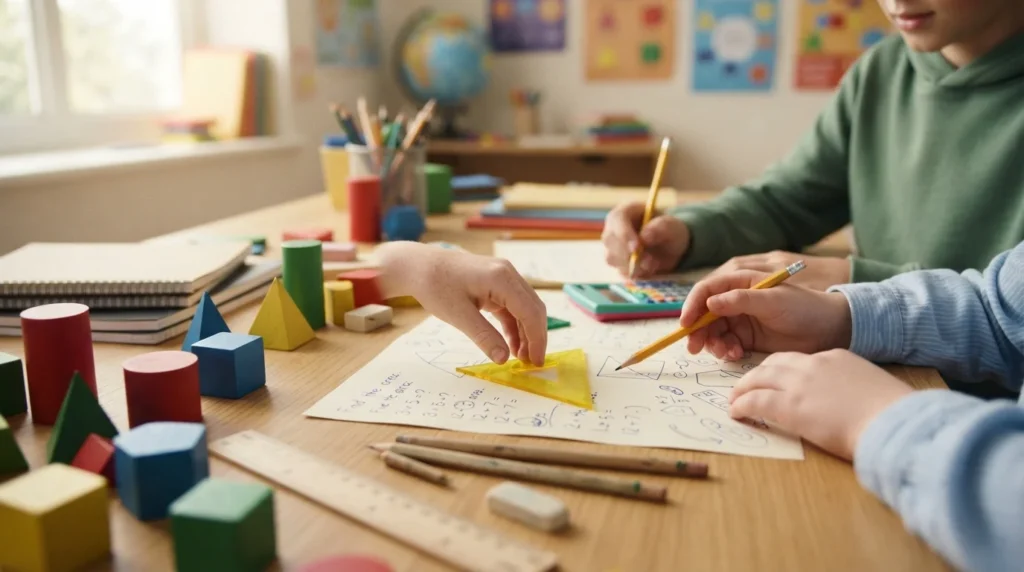
Why Math Jokes Belong in Every Kid’s Joke Collection
Math jokes have a special place in kid-friendly humor because they bring together two things that do not always get paired: learning and laughter. A silly number pun can make a child smile, but it can also remind them that math is full of patterns, creativity, and surprising connections.
The funniest math jokes are not always the ones with the biggest punchlines. Sometimes the best ones are simple enough that a child can understand them instantly and remember them for later. That is what makes a great kid’s joke worth sharing.
From counting jokes for younger children to algebra humor for older students, math comedy grows alongside a child’s curiosity. Every new math topic creates new opportunities for jokes:
- Shapes become characters with funny personalities.
- Numbers become silly storytellers.
- Equations become problems with emotions.
- Calculators become helpful sidekicks.
- Homework becomes a chance for a clever punchline.
Humor also reminds kids that making mistakes is part of learning. A joke about getting the wrong answer or struggling with a tricky problem can make those moments feel normal instead of frustrating.
The next time a child solves a tough equation, remembers a funny math pun, or shares a joke with a friend, they are building a stronger connection with numbers. Sometimes the easiest way to make math memorable is to add a little laughter along the way.
Because when it comes to math and humor, the answer is simple: the more you share, the more everyone counts.
Conclusion
Math does not have to be all formulas, homework, and serious faces. A well-timed joke can turn numbers into something fun, creative, and easier to enjoy. From silly number puns to geometry jokes and classroom one-liners, math humor gives kids a playful way to connect with ideas they see every day.
The best math jokes for kids do more than create a laugh. They encourage curiosity, creativity, and confidence. A child who enjoys a joke about fractions or equations may start looking at those same concepts with a little less frustration and a little more interest.
Whether the joke comes from a parent, teacher, or friend, sharing humor creates memorable moments. After all, the funniest lessons are often the ones kids remember long after the homework is finished.
So keep the calculators nearby, the pencils sharp, and the jokes ready. Because sometimes the easiest way to make numbers add up is to add a little laughter.
FAQs
What are some good math jokes for kids?
Good math jokes for kids are simple jokes that use numbers, shapes, equations, and math words in a funny way. The best ones are easy to understand, clean enough for classrooms, and memorable enough for children to share with friends and family.
Examples include jokes about calculators, fractions, geometry, counting, and everyday school experiences.
Why do kids enjoy math jokes?
Kids enjoy math jokes because they combine learning with surprise. A funny punchline helps children see numbers and math concepts in a more playful way.
Humor also makes difficult topics feel less stressful. When kids laugh while learning, they often become more comfortable talking about math.
Can math jokes help children learn?
Yes, math jokes can support learning by helping children remember concepts through wordplay and repetition. A joke about fractions, shapes, or equations can create a connection between a math idea and a funny memory.
While jokes do not replace practice, they can make learning feel more enjoyable.
What are the easiest math jokes for younger kids?
Younger kids usually enjoy simple jokes about counting, numbers, shapes, and objects they recognize. Jokes involving pencils, calculators, cookies, and basic addition are often easier for them to understand.
Short jokes with a clear punchline usually work best for younger children.
What type of math jokes do older kids like?
Older kids often enjoy jokes involving algebra, geometry, variables, and math vocabulary. They tend to appreciate humor that requires a little more thinking, especially jokes based on double meanings or clever wordplay.
The funniest jokes for older students often mix math knowledge with everyday situations.
Are math jokes good for classrooms?
Yes, classroom-friendly math jokes can make lessons more relaxed and engaging. Teachers can use them as warm-ups, icebreakers, or small rewards during lessons.
A quick joke can help students feel more comfortable participating and discussing math topics.
How can kids make their own math jokes?
Kids can create their own math jokes by choosing a math concept and adding a funny twist. They can give numbers personalities, create conversations between shapes, or use math words with double meanings.
Making jokes encourages creativity while helping children understand the ideas behind the humor.
References
- Merriam-Webster
- Cambridge Dictionary
- Encyclopaedia Britannica
- Oxford Reference