
What Is a Septum Piercing?

A septum piercing passes through the “sweet spot” — the thin, soft strip of tissue between your nasal septum cartilage and the tip of your nose — not through cartilage itself. That’s one of the biggest misconceptions people have before booking their appointment, and it’s part of why septum piercings tend to be more approachable than their reputation suggests.
This piercing has been part of body modification across cultures for centuries, but its modern popularity comes from its versatility. A septum piercing can sit boldly on display with a statement horseshoe, or tuck away completely with a retainer for days you need a more low-key look. Few piercings offer that kind of flexibility.
If you’re considering one, you’re probably weighing a handful of questions at once: Where exactly does the needle go? Will it hurt more than other piercings? What does healing actually look like, and what jewelry will you need to start? Those are fair questions, and the answers are more straightforward than a lot of scattered advice online makes them seem.
So, what is a septum piercing beyond the basics? Below, you’ll find the essentials — placement, healing basics, jewelry options, and what to expect cost-wise — pulled together in one place. This sits within our broader Septum Piercing Basics coverage, your starting point before diving into the finer details of pain, aftercare, or styling.
Where Is a Septum Piercing Located?
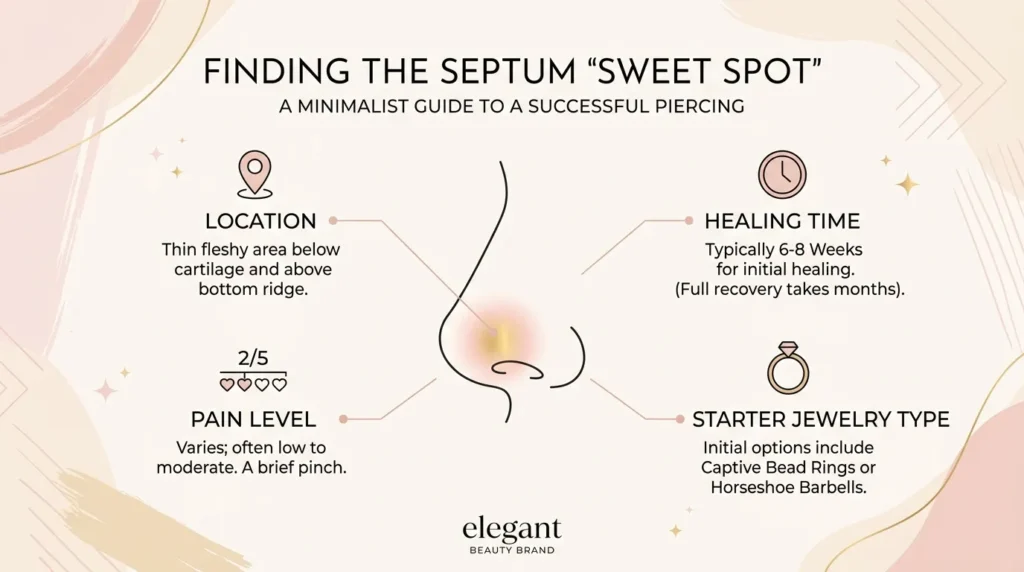
A septum piercing sits in the “sweet spot” — a small, flexible area of skin between the septal cartilage and the bottom of the nose, where nerve endings and cartilage density are lower than in the surrounding tissue. This is why an experienced piercer can typically locate it before ever picking up a needle, often by gently pinching the area to find the thinnest, most pliable spot.
Not everyone’s sweet spot sits in the same place. Nasal anatomy varies from person to person, which is one reason a skilled piercer will mark and confirm placement with you before piercing — rather than working from a fixed measurement. A piercing placed too low or too far back can end up going through cartilage instead, which tends to mean more pain, a longer healing process, and a higher chance of complications.
This is also why septum piercings are done by trained professionals rather than at home. A piercer needs to accurately locate the sweet spot, use sterile equipment, and place jewelry that fits the individual’s anatomy — none of which can be safely replicated without training and the right tools.
Septum Piercing at a Glance
- Location: The “sweet spot” between septal cartilage and the nose tip
- Pain level: Often described as a brief pinch or pressure, not sharp pain
- Initial healing: Roughly 6–8 weeks before it feels settled
- Starter jewelry: Circular barbell or septum retainer
- Average cost: Piercing fee plus jewelry, varies by studio and location
What Does “Sweet Spot vs. Cartilage” Actually Mean for You?
Not everyone’s septum anatomy is identical, and that’s normal. Some people have a naturally thinner, more defined sweet spot, while others have a slightly deviated septum — a common condition where the cartilage wall leans a bit to one side. Neither is a barrier to getting pierced, but it does affect how a piercer approaches placement.
With a deviated septum, an experienced piercer will often angle the piercing slightly to work with your natural anatomy rather than forcing a perfectly straight line that doesn’t match your nose. This is one of the clearest signs of a skilled piercer versus an inexperienced one — rushing this step, or not checking anatomy carefully before marking placement, is how piercings end up crooked or accidentally catching cartilage.
If you’re unsure whether your anatomy is straightforward or a little more complex, that’s a normal thing to ask about during a consultation. A good piercer will look, explain what they’re seeing, and walk you through their plan before ever picking up a needle.
How Is a Septum Piercing Different From Other Nose Piercings?
A septum piercing goes through the soft tissue at the base of the nose, while a nostril piercing goes through the flare of the nostril itself — meaning the two involve entirely different anatomy, healing processes, and jewelry styles. They’re often grouped as “nose piercings,” but the experience of getting and living with each one is fairly distinct.
Nostril piercings go through skin and a small amount of cartilage on the side of the nose, usually pierced with a stud or small hoop that stays visible at all times. A septum piercing, by contrast, can be flipped up and hidden inside the nose with a retainer — something a standard nostril piercing simply can’t do. That hide-away quality is one of the main reasons people choose septum over nostril, especially if they work somewhere that expects a more traditional appearance.
Healing also tends to differ. Nostril piercings go through more cartilage-adjacent tissue and can take longer to fully settle, sometimes several months to a year. A septum piercing, sitting in softer tissue, often reaches a comfortable healed state a bit sooner — though timelines still vary by person.
| Septum Piercing | Nostril Piercing | |
|---|---|---|
| Location | Sweet spot between cartilage and nose tip | Side of the nostril flare |
| Tissue type | Soft tissue | Skin with nearby cartilage |
| Can be hidden? | Yes, with a retainer | No, always visible |
| Typical healing time | ~6–8 months to fully heal | ~6–12 months to fully heal |
| Common starter jewelry | Circular barbell, retainer | Stud, small hoop |
Both are legitimate options worth considering on their own merits — the right choice comes down to how much visibility and versatility matter to you day to day.
What About High Nostril or Bridge Piercings?
High nostril and bridge piercings are sometimes grouped into the same conversation as septum piercings, but they involve entirely different placement and anatomy. A high nostril piercing sits higher up on the side of the nose, above the standard nostril spot, and goes through cartilage rather than soft tissue. A bridge piercing sits horizontally across the top of the nose, through a pinch of skin between the eyes — no cartilage or bone involved, but a fairly thin margin for error.
Both of these differ from a septum piercing in a key way: neither can be hidden. A bridge piercing sits front and center on the face, and a high nostril piercing, while smaller, is still always visible from the front. If versatility and the option to go undetected are part of what’s drawing you to a septum piercing, these alternatives won’t offer the same flexibility.
Healing also varies. Bridge piercings carry a higher rate of migration or rejection since they sit through such a thin layer of skin with nothing anchoring them structurally, which is worth knowing if you’re weighing multiple options rather than set on the septum specifically.
Does a Septum Piercing Hurt?
Most people describe septum piercing pain as a quick, sharp pinch followed by watery eyes and pressure, rather than a lasting ache — and it’s often less painful than the idea of a needle through your nose might suggest. Because the sweet spot is soft tissue rather than cartilage, the piercing itself tends to be over in a matter of seconds.
That said, pain tolerance is genuinely personal. Some people barely notice the pinch and are more startled by their eyes watering than anything else. Others find it more intense in the moment, even if it fades quickly. Neither reaction says anything about how the healing process will go from there.
One thing that catches people off guard: the watery eyes aren’t a sign of pain specifically. They’re a reflex tied to the nerves in that area of the nose, similar to what happens when something irritates your nostrils. It’s normal, it passes fast, and it doesn’t mean you’re more sensitive than the next person.
What Actually Happens During the Piercing Itself?
A septum piercing appointment typically takes just a few minutes from start to finish, and knowing the steps ahead of time tends to ease a lot of the pre-piercing nerves. After marking the sweet spot and getting your confirmation on placement, most piercers use a clamp to hold the tissue steady, which helps keep the needle path accurate and steady.
The needle itself is hollow, and the piercer pushes it through in one smooth, quick motion — this is the part that produces that brief pinch and the reflexive watery eyes mentioned earlier. Once the needle is through, the jewelry follows directly behind it, threaded into place in the same motion. From clamp to finished jewelry, the actual piercing portion is often over in under a minute.
Some piercers skip the clamp entirely, using a freehand technique instead, which some studios prefer for more precise placement. Neither method is inherently better — it comes down to piercer training and preference. What matters more is whether they clearly explain what they’re doing and why, since that transparency is usually a good sign of experience.
How Long Does a Septum Piercing Take to Heal?
A septum piercing typically takes around 6 to 8 months to fully heal, though many people feel comfortable changing jewelry or handling it with less caution after the first 2 to 3 months. Full healing simply means the fistula — the tunnel of tissue the jewelry sits in — has fully formed and stabilized, even if the piercing feels fine well before that point.
The first couple of weeks tend to bring the most noticeable symptoms: mild swelling, tenderness, and sometimes a bit of crust forming around the jewelry as the tissue starts to repair itself. This is a normal part of the process, not a sign that something’s gone wrong. After that initial phase, symptoms typically taper off, even while the tissue underneath is still quietly finishing its work.
Healing speed can vary based on factors like how well aftercare is followed, whether the jewelry gets bumped or irritated, and individual healing tendencies. Following your piercer’s specific aftercare instructions — generally centered around a sterile saline rinse and keeping the area clean — makes a meaningful difference in how smoothly things go.
What Are the Three Healing Stages?
Septum piercing healing generally moves through three stages: inflammation, proliferation, and maturation. Each stage looks and feels different, and knowing what’s normal at each point makes it easier to tell healthy healing from an actual problem.
The inflammation stage covers roughly the first two to three weeks. This is when swelling, tenderness, and mild discharge are most noticeable, as your body starts repairing the pierced tissue. Some light crusting around the jewelry is normal here — it’s dried lymph fluid, not a sign of infection.
The proliferation stage follows, typically lasting a couple of months. Swelling and redness taper off during this window, though some crusting can still show up periodically. This stage is often when people feel like the piercing is “basically healed,” even though tissue underneath is still stabilizing.
The maturation stage is the final and longest phase, where the fistula fully solidifies. This can continue well after the piercing feels completely normal day-to-day, which is why jewelry changes are generally recommended only after several months, not just once symptoms disappear.
What Jewelry Is Used for a Septum Piercing?
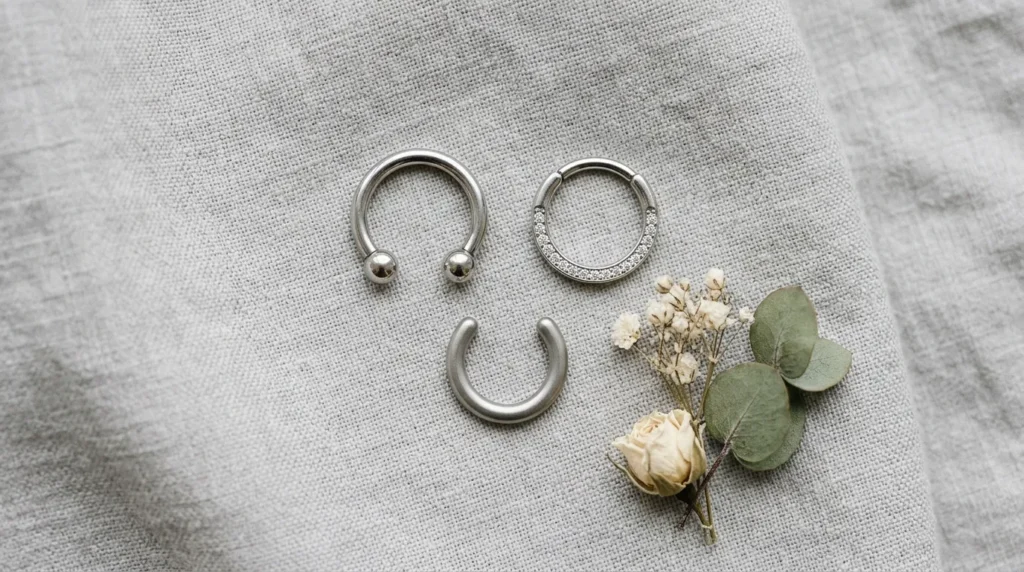
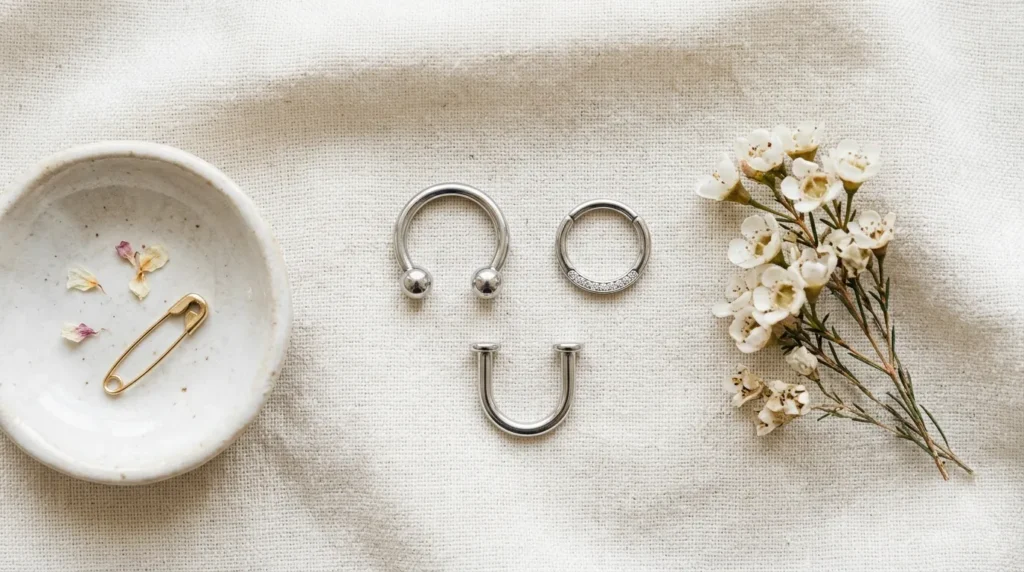
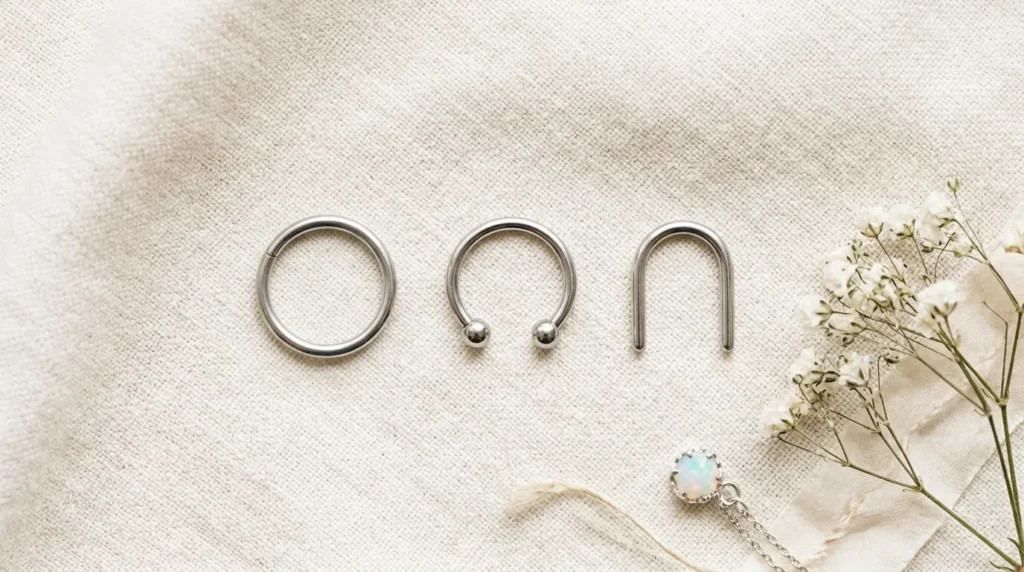
Most piercers start a septum piercing with a circular barbell or a septum retainer, both typically made from implant-grade titanium, niobium, or surgical steel to reduce the risk of irritation while the piercing heals. Starting jewelry is usually a slightly larger gauge — often 16g or 14g — which helps minimize migration and swelling in the early weeks.
A circular barbell is the classic choice: a horseshoe-shaped ring with removable beads on each end, sitting visibly at the base of the nose. A septum retainer, on the other hand, is shaped so it can be flipped up and tucked inside the nostrils, making it essentially invisible from the front. Many people ask for a retainer specifically because of workplaces or situations where visible piercings aren’t the norm.
Gold jewelry, particularly 14k, sometimes comes up as an option, but most reputable piercers recommend waiting until the piercing is fully healed before switching to gold or more decorative pieces. Fresh piercings do best with simple, body-safe materials rather than anything with plating, gemstones, or complex designs that are harder to keep clean.
Once healed, the styling options open up considerably — from delicate clickers to bold statement hoops. For a full breakdown of materials, gauge sizing, and how to choose jewelry at every healing stage.
Gold, Titanium, or Niobium — Which Should You Start With?
Implant-grade titanium is the most commonly recommended starter material for a septum piercing, largely because it’s hypoallergenic, non-porous, and well-tolerated by nearly all skin types, including sensitive ones. Niobium shares similar properties and is a common alternative, particularly for people who’ve had reactions to other metals in the past.
Surgical steel is sometimes used as well, though it contains trace amounts of nickel, which can be a concern for anyone with a known nickel sensitivity. If you have a history of metal allergies, mentioning it before your appointment lets your piercer choose the safest material from the start rather than dealing with irritation later.
14k gold, while a popular choice for healed piercings, generally isn’t recommended for initial jewelry. Fresh piercings do best with simple, smooth, body-safe metals — gold pieces often come with more intricate designs or settings that are harder to keep clean during the healing window. Once your piercing is fully healed, gold becomes a much more reasonable option to introduce.
Is a Septum Piercing Permanent?
A septum piercing is not permanent in the way a tattoo is — if you remove the jewelry, the hole can shrink or close, sometimes within a matter of hours if the piercing is still fresh, or gradually over weeks to months once fully healed. How quickly it closes depends largely on how long you’ve had it and how developed the fistula is.
Freshly pierced septums close the fastest, since the tissue hasn’t had time to form a stable, healed channel. Even a piercing that’s several months into healing can shrink noticeably if jewelry is left out for just a day or two. Fully healed piercings, on the other hand, tend to be more resilient — some people find their hole stays open indefinitely, even after months without jewelry, while others notice it closing within a matter of weeks.
There’s no universal timeline here, since it depends on individual healing, how long the piercing was in place, and general skin characteristics. If you’re removing the piercing for a specific reason, like a workplace requirement or medical procedure, ask your piercer about non-metallic retainer options that can keep the hole open without being visible, rather than removing jewelry entirely and hoping the hole stays put.
If you decide you don’t want the piercing anymore, no special removal process is needed beyond taking the jewelry out. Continuing basic aftercare until the area fully closes helps avoid irritation during that transition.
How Much Does a Septum Piercing Cost?
A septum piercing typically costs between the piercing fee and the price of starter jewelry, with the total usually landing higher than a basic earlobe piercing due to the skill involved and the quality of jewelry required. Exact pricing varies significantly by studio reputation, location, and the type of starter jewelry you choose.
Reputable piercers charge more not because of upselling, but because proper training, sterile equipment, and implant-grade jewelry all come at a real cost — and cutting corners here is where complications tend to start. It’s generally worth avoiding studios that price significantly below market rate for the area, since that can be a sign of lower-quality jewelry or less rigorous sterilization practices.
Beyond the initial piercing, budgeting for aftercare essentials (like a sterile saline solution) and eventually a second piece of jewelry once healed is worth factoring into the overall cost. Some studios include aftercare basics in their piercing fee; others don’t, so it’s worth asking upfront.
Is a Septum Piercing Right for You?
A septum piercing tends to suit people who want versatility — the option to wear bold jewelry one day and hide it completely the next — more than it suits anyone looking for a fully permanent, always-visible statement. That flexibility is genuinely one of its biggest draws, but it’s worth thinking through a few practical factors first.
Workplace and lifestyle matter here. If your job has a conservative dress code, a retainer makes a septum piercing easy to keep private during work hours. Active lifestyles are worth considering too — anyone playing contact sports or working in environments where face coverings are common should think about how jewelry might interact with masks, helmets, or physical activity during healing.
It’s also worth being honest about aftercare commitment. Like any piercing, a septum piercing needs consistent, simple care during healing — nothing complicated, but it does require a few minutes of attention daily for the first couple of months.
If those factors line up with your lifestyle, a septum piercing is a well-established, generally well-tolerated piercing with decades of practice behind it at reputable studios. The next step is finding an experienced piercer, ideally one who follows guidance from the Association of Professional Piercers, and asking any remaining questions directly before booking.
Conclusion
A septum piercing offers something few other piercings can: the choice to wear it boldly or keep it completely private, depending on the day. Placed through soft tissue rather than cartilage, it tends to be more approachable than people expect — both in terms of the piercing itself and the healing process that follows.
If you’re ready to move forward, the details matter more than the general overview. Talk to an experienced piercer, ask about their sterilization practices and jewelry materials, and don’t rush the healing process once it’s done. The payoff is a piercing that adapts to your life, rather than the other way around.
Frequently Asked Questions
Is a septum piercing through cartilage?
No. It goes through the “sweet spot,” a soft tissue area between the septal cartilage and the tip of the nose. Piercing through cartilage itself is a different, more complex procedure that a trained piercer will avoid when locating proper placement.
Can you hide a septum piercing?
Yes, with a septum retainer, which is shaped to flip up and tuck inside the nostrils so it’s not visible from the front. This is one of the main reasons people choose a septum piercing over other nose piercings.
Are septum piercings appropriate for the workplace?
It depends on the workplace, but many people manage this by using a retainer during work hours and switching to visible jewelry outside of it. Some industries and companies have become more relaxed about visible piercings in recent years, though policies still vary.
Does a septum piercing hurt more than a nostril piercing?
Pain is subjective, but many people report septum piercings feel similar to or less intense than nostril piercings, since the sweet spot involves soft tissue rather than cartilage. Watery eyes are a common reflex during the piercing, not necessarily a sign of pain.
How soon can you change septum jewelry?
Most piercers recommend waiting until the piercing is substantially healed, often several months in, before switching jewelry — though many people find their piercer comfortable with a jewelry change earlier if healing is progressing well. It’s best to ask your specific piercer rather than follow a fixed timeline.
Do septum piercings smell during healing?
A mild odor can occur during healing due to natural discharge and lymph fluid, which is common with most fresh piercings. A persistent strong odor, along with other symptoms like excessive discharge or swelling, is worth having a piercer or doctor take a look at.
Can anyone get a septum piercing?
Most healthy adults are good candidates, though people with certain medical conditions, allergies to piercing materials, or who are pregnant or breastfeeding should talk to a doctor or experienced piercer first. Reputable studios also have specific age and consent requirements for anyone under 18.
Content Reviewer Disclosure
This article was reviewed by James Mitchell, Editorial Reviewer for body piercing content at The Velvet Magazine. Every guide is checked for factual accuracy, editorial quality, and alignment with reputable industry guidance — including standards set by the Association of Professional Piercers — before publication, to make sure readers get clear, reliable information.
Reviewed on July 16, 2026.
Author Bio
Emily Carter is a fashion and beauty writer at The Velvet Magazine, specializing in body jewelry, piercing trends, and personal style. She creates well-researched, reader-friendly guides that help readers confidently explore modern piercing culture, jewelry styling, and beauty trends.
References
- Association of Professional Piercers (APP) — Official Aftercare Guidelines
- Association of Professional Piercers (APP) — About the Organization
- Association of Professional Piercers (APP) — Educational Brochures (Jewelry for Initial Piercings, Troubleshooting, Picking Your Piercer)
- Healthline — Septum Piercing: 13 FAQs About Pain, Cost, and More